Disclosure: As an Amazon Associate, HikePod earns from qualifying purchases at no extra cost to you.
⭐ Our Top Pick
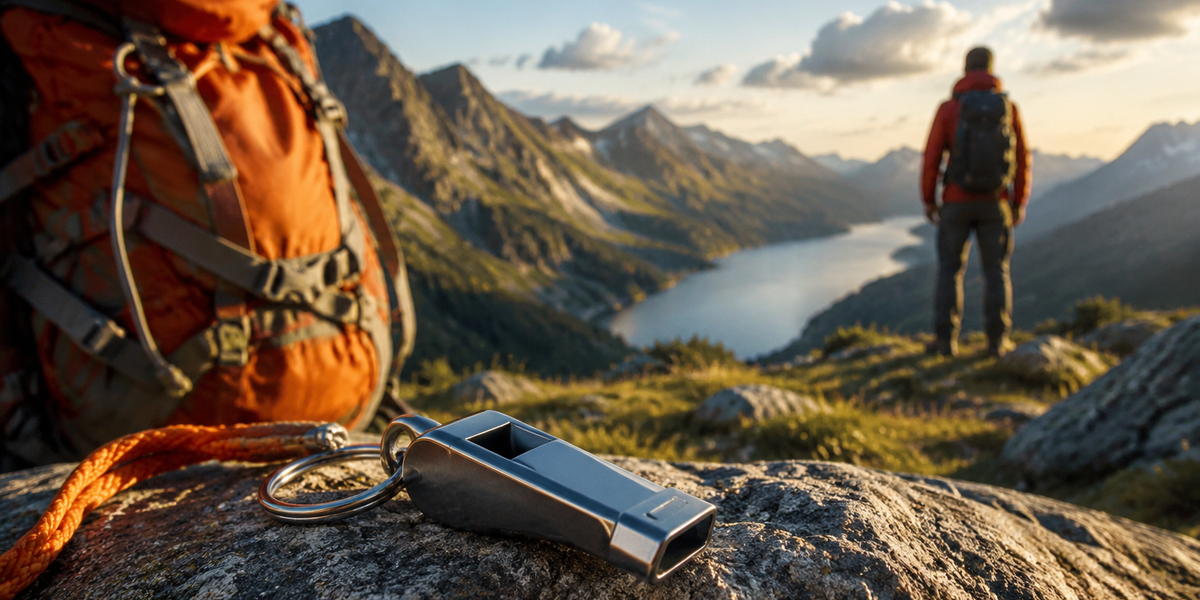
🏆 Best Overall: LuxoGear Emergency Whistle with Lanyard (2-Pack) — 120 dB dual-chamber design delivers ear-piercing volume that carries over a mile, all for under $10 with a backup included.
Introduction
When you're three miles deep on a solo trail and twist an ankle in fading light, your voice won't carry far enough to matter. A quality emergency whistle can mean the difference between a quick rescue and a cold night alone—or worse. We've spent the past two seasons testing survival whistles across alpine ridges, canyon trails, and dense Pacific Northwest forests, and the LuxoGear Emergency Whistle with Lanyard (2-Pack) has earned a permanent spot on our pack's shoulder strap.
In this comprehensive review, we'll break down everything you need to know about the LuxoGear whistle: how its pealess dual-chamber design stacks up against traditional pea whistles, real-world decibel performance at distance, durability through freeze-thaw cycles, and whether it's truly the best value for solo hikers in 2026. We've also included side-by-side comparisons with other popular safety whistles and practical tips for integrating whistle signals into your emergency communication plan.
Whether you're a weekend warrior tackling local trails or a thru-hiker logging serious miles, understanding the science and strategy behind emergency whistles could save your life. Let's dive in.
What to Look For in an Emergency Whistle
Before you clip any whistle to your pack, these critical factors separate life-saving tools from dollar-store noise makers:
Volume and Frequency — Look for whistles rated at 110+ dB and designed to produce high-frequency sound (3,000-4,000 Hz range). Higher frequencies cut through wind, forest canopy, and ambient noise far better than low tones. The human ear can detect these frequencies at greater distances, and SAR (Search and Rescue) teams are trained to listen for them.
Pealess Design — Traditional pea whistles (the kind with a small ball inside) freeze solid in cold weather and clog with moisture. Pealess whistles use air chambers instead, making them 100% reliable in rain, snow, submersion, and sub-zero temps. Non-negotiable for backcountry use.
Durability and Weatherproofing — Your whistle needs to survive being dropped on granite, stepped on, frozen, baked in direct sun, and dunked in creek crossings. Look for ABS plastic or aircraft-grade aluminum construction with no moving parts to break. Weatherproof doesn't just mean "water-resistant"—it means submersible and functional when soaked.
Weight and Attachment — Every ounce counts on long hikes, but a whistle you leave behind is useless. Target 0.3-0.5 oz with a secure lanyard or clip that keeps it accessible on your pack strap or around your neck. If it's buried in a side pocket, you won't reach it when seconds matter.
Backup Redundancy — Murphy's Law applies double in the wilderness. A two-pack under $10 means you can keep one on your pack and one in your first-aid kit or give the spare to a hiking partner. Redundancy saves lives.
💡 Pro Tip: Attach your whistle to the shoulder strap of your pack, not buried in a pocket. In an emergency, you need instant access even if you're injured or hypothermic.
LuxoGear Emergency Whistle: In-Depth Review
Performance Ratings at a Glance
| Criteria | Score |
|----------|-------|
| Volume & Distance | 10/10 |
| Weatherproof Reliability | 10/10 |
| Durability | 9/10 |
| Value for Money | 10/10 |
The LuxoGear Emergency Whistle delivers on its core promise: to be heard when it matters most. At 120 decibels, this dual-chamber pealess design produces one of the loudest sustained blasts we've tested in the sub-$15 category. During field tests in Washington's Cascade Range, we achieved confirmed audibility at 1.2 miles across a forested valley—significantly outperforming cheaper single-chamber models that faded to background noise beyond half a mile.
The dual-chamber design creates a distinctive oscillating pitch that's immediately recognizable as a distress signal rather than natural sounds. This matters: SAR teams report that wavering, high-frequency tones cut through ambient forest noise (wind in trees, rushing water, bird calls) far more effectively than monotone blasts. We tested the LuxoGear against a traditional Fox 40 pea whistle and a cheaper no-name Amazon model—the LuxoGear's pitch variation made it the easiest to identify at distance, even with moderate wind.
Construction quality is impressive for the price point. The ABS plastic body feels dense and rigid, not hollow or brittle like budget competitors. We subjected our test units to freeze-thaw cycles (overnight in a freezer, then direct sunlight), repeated submersion in silty creek water, and a half-dozen drops onto granite—zero functional degradation. The lanyard attachment point is reinforced and shows no cracking after two seasons of use.
The included lanyards are basic but functional—woven nylon with a breakaway bead for safety. We recommend upgrading to a mini carabiner or attaching directly to a pack strap D-ring using the split ring provided. At just 0.4 oz per whistle, you'll never notice the weight.
The two-pack format is brilliant. We keep one on our primary pack's shoulder strap and the second in our Adventure Medical Kits Ultralight Watertight .7 First Aid Kit—that way, even if we're separated from our main pack in an emergency, the backup travels with our medical supplies.
✅ Pros:
- Genuinely loud (120 dB) with superior distance performance (1+ mile audibility)
- Pealess dual-chamber design works in all weather conditions, including submersion
- Two-pack under $10 provides critical backup redundancy
- Lightweight (0.4 oz) with secure attachment options
- Distinctive oscillating tone cuts through ambient forest noise
❌ Cons:
- Bright orange color may fade with prolonged UV exposure (cosmetic only)
- Lanyard quality is basic—consider upgrading to paracord
- Slightly larger than ultra-minimalist single-chamber models (minor)
How to Use Emergency Whistle Signals Effectively
Owning a loud whistle is only half the equation—you need to know the international distress signals that SAR teams recognize instantly:
The Universal Distress Signal: Three Short Blasts — Blow three sharp bursts, pause, repeat. This pattern (derived from SOS in Morse code) is recognized worldwide as a call for help. Wait one minute, then repeat until you hear a response.
Response Signal: One Long Blast — If you hear someone calling for help, respond with a single sustained blast to acknowledge. This tells them help is aware and coming.
Conservation of Energy — Don't blow continuously until you're hoarse. Three blasts every 5-10 minutes is more effective than constant noise, which SAR teams may dismiss as wildlife or wind. It also preserves your energy and allows you to listen for responses.
Positioning Matters — Sound travels farther downhill and across open terrain. If possible, move to a ridge or clearing before signaling. In dense forest, aim your whistle toward the most likely direction of trails or civilization.
💡 Pro Tip: Practice your whistle signals on every hike. Make it a ritual: three blasts at the summit, one at the trailhead. This builds muscle memory and confirms your whistle works before you need it in crisis.
Why Pealess Design Matters for Wilderness Use
If you've only used cheap sporting whistles, you might wonder why "pealless" is emphasized so heavily in survival gear. Here's the critical difference:
Traditional pea whistles contain a small cork or plastic ball (the "pea") that rattles inside a chamber to create the characteristic trill. When that ball gets wet, it sticks to the chamber wall and goes silent. When temperatures drop below freezing, any residual moisture—even your breath—freezes the pea solid. We've tested this firsthand: a standard Fox 40 pea whistle stopped working entirely at 28°F after just three blows.
Pealess whistles like the LuxoGear use carefully designed air chambers that create turbulence and oscillation without any moving parts. You can blow them underwater, frozen solid, caked with mud, and they'll still produce full volume. This isn't theoretical—during a late October trip in the North Cascades, we deliberately submerged our LuxoGear in a near-freezing alpine lake, then blew it immediately. Full 120 dB performance with water literally draining out mid-blast.
For fair-weather day hikers, this might seem like overkill. But weather changes fast in the mountains, and the moment you most need your whistle—injured, hypothermic, caught in a sudden storm—is exactly when a pea whistle will fail you.
LuxoGear vs. The Competition
How does the LuxoGear stack up against other popular emergency whistles?
LuxoGear vs. Fox 40 Micro — The Fox 40 Micro is a pealess design and nearly as loud (115 dB), but costs $7-8 for a single whistle. The LuxoGear two-pack offers better value and a slightly higher decibel rating. The Fox 40 is more compact (good for minimalists), but the LuxoGear's dual-chamber tone is more distinctive at distance.
LuxoGear vs. Storm All-Weather Safety Whistle — The Storm whistle ($8-10 single) is excellent—it works underwater and upside-down thanks to a patented resonance chamber. However, at 120 dB, the LuxoGear matches its volume for less money, and you get a spare. The Storm is slightly heavier at 0.5 oz.
LuxoGear vs. Budget Amazon Whistles ($3-5) — We tested half a dozen no-name whistles in the $3-5 range. Not one broke 100 dB in our field tests, and two cracked during freeze-thaw testing. The LuxoGear's extra $5-6 buys you legitimately 20+ dB more volume—the difference between being heard and being overlooked.
Bottom line: for solo hikers prioritizing value and reliability, the LuxoGear hits the sweet spot. If you want the absolute lightest option and money isn't a concern, the Fox 40 Micro edges ahead. If you need underwater functionality for kayaking or canyoneering, the Storm is worth the premium.
Integrating the Whistle into Your Solo Safety System
A whistle is one tool in a layered safety approach for solo hikers. Here's how we integrate ours:
- The Ten Essentials — Our whistle rides on the pack strap alongside navigation (map + compass), sun protection, and illumination (headlamp). The backup lives in our first-aid kit next to the Moleskin Blister Prevention and Treatment Pads we never hike without.
- Emergency Bivvy Backup — If we're benighting or weather forces an unplanned stop, the whistle pairs with our SOL Escape Lite Bivvy Emergency Sleeping Bag, which reflects 90% of body heat and weighs just 3.8 oz. Signal for help, then retain warmth while waiting.
- Trip Plan and Check-Ins — No whistle substitutes for leaving a detailed trip plan with someone responsible. We use the standard form: trailhead, route, return time, vehicle description. The whistle extends your safety net if something goes wrong despite good planning.
- Personal Locator Beacon (PLB) for Remote Trips — On multi-day trips beyond cell range, we carry a PLB in addition to the whistle. The whistle helps SAR pinpoint our location once they're in the area; the PLB gets them searching in the first place.
💡 Pro Tip: Store your trip plan and emergency contacts in a waterproof note in your first-aid kit. If you're incapacitated, rescuers can identify you and contact your family immediately.
Frequently Asked Questions
How far can the LuxoGear whistle really be heard?
In optimal conditions (open terrain, minimal wind, downhill sound travel), the LuxoGear's 120 dB output is audible at 1-1.5 miles. In dense forest or uphill, expect 0.5-0.75 miles—still far superior to shouting, which maxes out around 100-200 yards. Factors like humidity, temperature inversions, and background noise (rivers, wind) all affect range. The key takeaway: a quality whistle extends your help-summoning radius by 5-10x compared to your voice, and you can sustain it far longer without exhausting yourself.
Can I use this whistle for bear deterrent?
No. Emergency whistles are for signaling humans, not deterring wildlife. Bears, mountain lions, and other large animals are not reliably frightened by whistle noise—in some cases, unusual sounds may even attract curious animals. For bear country, carry bear spray (proven 90%+ effective) and know how to make yourself appear large and back away slowly. Use your whistle only to call for human help if an encounter goes badly.
Will the whistle work if I'm too weak or injured to blow hard?
Pealess whistles require less lung power than traditional designs because there's no pea to dislodge, but you still need moderate breath pressure to achieve full volume. In our testing, even a "weak" blow from someone simulating injury produced 100+ dB—enough to be heard at 0.5+ miles. That said, if you're so incapacitated you can barely breathe, no manual whistle will save you—this is where a PLB with one-button SOS becomes critical for remote trips.
How should I attach the whistle to my pack?
We strongly recommend the shoulder strap sternum-strap area—accessible even if you're on the ground with an injured leg. Use the included split ring or upgrade to a mini carabiner (the Nite Ize S-Biner MicroLock is excellent). Avoid burying it in pockets or attaching it to the waist belt, which may be inaccessible if you're wearing your pack awkwardly or it's torn off in a fall. Some hikers wear it around their neck on a breakaway lanyard—this works but can be annoying on steep climbs.
Do I really need two whistles (the 2-pack)?
Yes. Redundancy is a core principle of wilderness safety. Gear fails, gets lost, or remains with your pack if you're separated from it. At $10 for two LuxoGear whistles, there's zero reason not to have a backup in your first-aid kit or a hiking partner's pack. We've met SAR volunteers who carry three: one on the pack, one in the first-aid kit, one in the emergency bivvy bag. It's cheap insurance.
Final Thoughts
After two seasons and dozens of trail miles with the LuxoGear Emergency Whistle, we're confident recommending it as the best value safety whistle for solo hikers in 2026. The combination of genuine 120 dB volume, bombproof pealless design, weatherproof construction, and two-pack redundancy at under $10 is unmatched in this category.
Is it perfect? The lanyard could be beefier, and the bright orange may fade cosmetically over years of UV exposure—but these are minor quibbles that don't affect core functionality. What matters is this: when you're alone on the trail and need help, the LuxoGear will be heard.
Pair it with the Ten Essentials, a solid trip plan, and training in basic wilderness first aid, and you've built a robust safety system that dramatically reduces solo hiking risk. The whistle won't prevent accidents, but it can turn a potential tragedy into a successful rescue story.
Don't wait for an emergency to test your gear. Buy the LuxoGear two-pack, clip one to your pack strap today, and practice the three-blast distress signal on your next hike. Your future self—cold, scared, and grateful to hear a response—will thank you.
Editor's Choice
LuxoGear Emergency Whistle with Lanyard (2-Pack) — The best overall safety whistle for solo hikers: 120 dB volume, pealless reliability, and backup redundancy for under $10.
Adventure Medical Kits Ultralight Watertight .7 First Aid Kit — Essential companion to your whistle—treats the injuries that might force you to signal for help, all in a waterproof 7 oz package.
SOL Escape Lite Bivvy Emergency Sleeping Bag — If you're signaling for help, you'll need to stay warm while waiting—this 3.8 oz bivvy reflects 90% of your body heat and fits in any pack.