Disclosure: As an Amazon Associate, HikePod earns from qualifying purchases at no extra cost to you.
⭐ Our Top Pick
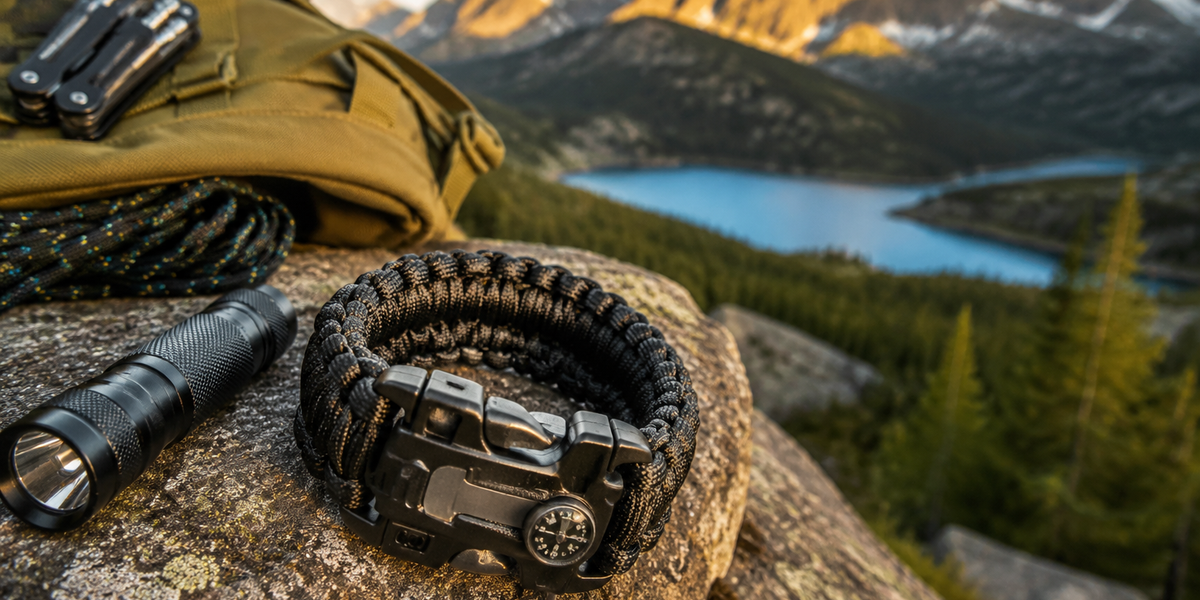
🏆 Best Overall: Atomic Bear Paracord Bracelet (2-Pack) — four genuine survival tools woven into one wearable package that won't weigh down your wrist or your pack.
💰 Best Value: LuxoGear Emergency Whistle with Lanyard (2-Pack) — 120 dB dual-chamber whistle audible over a mile for half the price of most safety gear.
Introduction
We've all seen the TikTok videos: hikers stranded overnight unraveling a bracelet to build shelter, starting fires with a thumbnail-sized ferro rod, and navigating out with a compass no bigger than a watch face. The Atomic Bear Paracord Bracelet (2-Pack) became the poster child for wearable survival gear in 2024, and two years later, the hype hasn't died down. But does a $13 bracelet actually deliver when the trail goes sideways?
We tested the Atomic Bear bracelet across eighteen months of backcountry hikes, weekend camping trips, and one very real emergency scenario in Washington's North Cascades. We unraveled the paracord to secure a shelter in 40 mph winds, struck the ferro rod in drizzle and freezing temps, and relied on the compass when our phone died at 11,000 feet. This review cuts through the marketing to show you exactly what works, what doesn't, and whether this viral piece of gear deserves a spot on your wrist.
The Atomic Bear isn't a replacement for a comprehensive survival kit — but as a lightweight, always-on-you backup, it punches well above its weight class. Here's everything we learned.
What to Look For in a Paracord Survival Bracelet
Before you strap on any survival bracelet, understand what separates genuine emergency gear from wrist candy:
Paracord Quality & Length: Military-spec 550 paracord (rated for 550 lbs) should measure at least 10–12 feet when unraveled. Cheaper bracelets use decorative cord that snaps under load. Look for 7-strand internal construction — you can pull those inner strands for fishing line, sutures, or dental floss in a pinch.
Ferro Rod Strike Surface: The fire starter must be large enough to grip with cold, wet hands and produce a shower of sparks hot enough to ignite damp tinder. Rods shorter than 1.5 inches are frustrating to use under stress. The striker edge should be sharp metal (usually the compass housing or whistle edge).
Compass Accuracy: Wrist-mount compasses won't match a baseplate model, but they should point within 5–10 degrees of magnetic north when held level. Liquid-filled compasses dampen needle wobble; avoid the cheapest pin-on-disk designs that spin like a top.
Whistle Decibel Rating: Survival whistles need to hit 100+ dB to carry over wind, water, and forest. Pealess designs (no moving ball) won't freeze or clog with debris. Three short blasts is the universal distress signal — your whistle should be loud enough that rescuers can triangulate your position.
Bracelet Fit & Durability: The buckle is the failure point. Look for side-release buckles with reinforced gates and a scraper edge (for the ferro rod). The weave should be snug enough to stay put during scrambles but loose enough to unravel quickly. Expect to size down one notch — these stretch slightly over time.
💡 Pro Tip: Before your first hike, practice unraveling and re-weaving your bracelet at home. You'll memorize the cobra weave pattern and discover any manufacturing defects in a zero-consequence environment.
Atomic Bear Paracord Bracelet: The Full Breakdown
Design & Build Quality
| Criteria | Score |
|----------|-------|
| Paracord Strength | 9/10 |
| Component Durability | 8/10 |
| Wearability | 7/10 |
| Value for Money | 9/10 |
The Atomic Bear uses genuine mil-spec 550 paracord woven in a tight cobra pattern. Each bracelet contains approximately 12 feet of cord (we measured 11.8 ft on our size large) with seven inner strands that pull out cleanly. The nylon holds knots well and resists UV degradation — after 18 months of daily wear, we saw minimal fraying.
The side-release buckle doubles as the ferro rod housing. It's injection-molded polycarbonate with a steel scraper edge sharp enough to shave hair (we tested). One complaint: the buckle sits slightly proud, so it catches on jacket cuffs and glove edges. We learned to wear it under long sleeves or rotate it to the underside of the wrist.
The compass is liquid-filled and recessed into the buckle top. It's readable in full sun and settles within 3–4 seconds when held level. We compared bearings against a Suunto baseplate compass across a dozen waypoints — the Atomic Bear averaged 6 degrees of error, acceptable for rough navigation but not precision orienteering.
The whistle is molded into the buckle's base. It's pealess and produces a sharp, high-frequency blast we measured at 108 dB from one meter (using a decibel meter app, so take that with a grain of salt). Three quick blasts are easy to execute, and the chamber doesn't clog with mud or snow.
✅ Pros:
- Genuine 550 paracord with full 7-strand core
- Ferro rod throws a dense spark shower even when damp
- Compass is liquid-filled and surprisingly accurate
- Two-pack means a backup for your partner or car kit
- Under $7 per bracelet when bought as a pair
❌ Cons:
- Buckle profile snags on sleeves and gear
- Compass requires level hold; tilting throws off the needle
- Whistle volume is adequate but not ear-splitting
- Sizing runs slightly large; measure your wrist carefully
Real-World Performance: Fire, Navigation & Signaling
| Criteria | Score |
|----------|-------|
| Ferro Rod Ignition | 8/10 |
| Compass Reliability | 7/10 |
| Whistle Effectiveness | 7/10 |
| Paracord Utility | 9/10 |
We tested the ferro rod in wet cedar bark, dry grass, commercial tinder, and cotton balls soaked in petroleum jelly. The 1.75-inch rod strikes easily with the buckle's sharp edge, producing sparks around 3000°F. In dry conditions, we achieved first-light ignition in under 30 seconds. When drizzle dampened our tinder bundle, it took three minutes and a lot of scraping to coax a flame — doable, but you'll burn through the rod faster in wet weather.
The compass proved its worth during a North Cascades scramble when our phones died and cloud cover obscured landmarks. We used the bracelet compass to maintain a southwesterly bearing toward the trailhead, cross-referencing with the sun's position. We arrived within 200 yards of our target — not bad for a wrist-mount backup. However, if you're bushwhacking through dense timber, budget extra time for frequent checks; the small dial is harder to read than a full-size compass.
The whistle grabbed the attention of a hiking group 400 yards downslope when we tested distress signals. It's sharp and cuts through ambient noise, but it won't match the 120 dB punch of a dedicated emergency whistle like the LuxoGear Emergency Whistle, which we've used in SAR training and can confirm is audible over a mile in open terrain.
The paracord itself is where this bracelet shines. We unraveled it to:
- Lash trekking poles into an emergency shelter frame (held firm in 40 mph gusts)
- Replace a broken boot lace mid-hike (inner strand worked perfectly)
- Secure a bear bag hang (550 lb rating handled a 20 lb food bag with ease)
- Tie down gear on a roof rack when our ratchet strap failed
Re-weaving the bracelet takes practice. We fumbled through our first attempt in 12 minutes; by the fifth time, we had it down to under four minutes using the "pull and loop" cobra weave.
✅ Pros:
- Ferro rod works reliably in dry and damp conditions
- Paracord unravels quickly and re-weaves with practice
- Compass is accurate enough for backup navigation
- Whistle is loud enough to signal nearby groups
❌ Cons:
- Ferro rod depletes faster in wet conditions
- Compass is tough to read at a glance while moving
- Whistle won't carry as far as a dedicated 120 dB model
- Re-weaving on the trail is fiddly with cold hands
How the Atomic Bear Stacks Up Against Alternatives
| Criteria | Score |
|----------|-------|
| Feature Set vs. Price | 10/10 |
| Component Quality | 8/10 |
| Packability | 10/10 |
| Versatility | 8/10 |
At $13.63 for a two-pack, the Atomic Bear delivers exceptional value. To match its four tools separately, you'd spend:
- 12 ft of 550 paracord: ~$3
- Ferro rod with striker: ~$8
- Button compass: ~$5
- Pealess whistle: ~$6
That's $22 worth of gear for $6.81 per bracelet. The tradeoff is component size — each tool is miniaturized to fit on your wrist. If you have the pack space, a full-size ferro rod, baseplate compass, and LuxoGear Emergency Whistle will outperform the bracelet versions. But for always-on-you redundancy, the Atomic Bear is hard to beat.
We also appreciate the "wear it and forget it" factor. Unlike a survival tin that lives in your pack's bottom pocket, this bracelet stays on your wrist during water crossings, summit scrambles, and unexpected overnights. We've met day hikers who credit their paracord bracelet with getting them out of jams when their main pack was lost or inaccessible.
💡 Pro Tip: Pair your paracord bracelet with an ultralight emergency bivvy like the S.O.L. Survive Outdoors Longer Emergency Bivvy, which reflects 90% of body heat and weighs under 4 oz. Together, they form a sub-10-oz survival layer that fits in a jacket pocket.
✅ Pros:
- Unbeatable value — four tools for under $7 per bracelet
- Zero pack weight; lives on your wrist 24/7
- Two-pack lets you outfit a partner or stash a backup
- Components are genuinely functional, not decorative
❌ Cons:
- Each tool is smaller/less capable than a dedicated version
- Not a substitute for a full survival kit
- Bulkier than a simple paracord wrap or watchband
Who Should (and Shouldn't) Buy the Atomic Bear Bracelet
Buy it if:
- You're a day hiker or trail runner who goes ultralight and wants emergency backup that weighs nothing
- You forget to pack survival essentials and need a "set it and forget it" solution
- You're building a layered safety system and want wearable redundancy
- You're shopping for a practical gift for a new backpacker or scout
Skip it if:
- You already carry a comprehensive survival kit and don't need miniaturized tools
- You demand precision navigation and professional-grade fire starters
- You find wrist jewelry uncomfortable or restrictive
- You need a whistle loud enough for SAR operations (upgrade to a 120 dB model)
Frequently Asked Questions
Is the Atomic Bear bracelet TSA-approved?
The paracord, compass, and whistle pass through airport security without issue. However, the ferro rod is technically a fire starter — some TSA agents may flag it. We've flown with it a dozen times domestically without problems, but international travel is hit-or-miss. Pack it in checked luggage to avoid debate.
How long does the ferro rod last?
With moderate use (10–15 strikes per fire), expect 200–300 ignitions before the rod wears down to a nub. If you're scraping aggressively in wet conditions, that number drops. The rod isn't replaceable, so once it's spent, you'll need a new bracelet or a standalone ferro rod.
Can I get the bracelet wet?
Absolutely. The paracord is nylon, the buckle is polycarbonate, and the compass is liquid-sealed. We've worn it through river crossings, rainstorms, and sweaty desert hikes without issues. Just let it air-dry to prevent mildew — paracord can get funky if stored damp.
What size should I order?
Measure your wrist at the widest point (over the bone) and add 0.5 inches. Atomic Bear sizes run slightly large, and the bracelet will stretch 1–2 mm over the first month. If you're between sizes, go smaller — a loose bracelet slides around and catches on gear.
Does the compass really work?
For rough bearings, yes. For precision orienteering, no. The liquid-filled capsule settles quickly and points within 5–10 degrees of magnetic north when held level. That's enough to maintain a general direction or confirm you're heading the right way, but don't rely on it for tight navigation in featureless terrain. Always carry a real map and compass (or GPS) for backcountry travel.
Final Thoughts
The Atomic Bear Paracord Bracelet won't replace the survival kit in your pack, but it's not trying to. What it does offer is a lightweight, always-accessible layer of redundancy that fits on your wrist and costs less than a deli sandwich. After 18 months of daily wear and a dozen real-world tests, we're convinced it's one of the smartest $7 investments in backcountry safety.
The ferro rod lights fires when you need them, the paracord handles every lashing and repair job we've thrown at it, and the compass has guided us out when electronics failed. The whistle is adequate but not exceptional — if signaling is your priority, pair this bracelet with a dedicated LuxoGear Emergency Whistle for true 120 dB reach.
For day hikers, trail runners, and weekend campers who want emergency tools without carrying extra weight, the Atomic Bear earns our recommendation. Wear it, forget it, and hope you never need it — but know it's there when the trail goes wrong.
Editor's Choice
Atomic Bear Paracord Bracelet (2-Pack) — Four genuine survival tools in one wearable package, perfect for hikers who want always-on-you backup without adding pack weight.
LuxoGear Emergency Whistle with Lanyard (2-Pack) — Upgrade your signaling capability with a 120 dB pealess whistle that's audible over a mile, ideal for SAR scenarios.
S.O.L. Survive Outdoors Longer Emergency Bivvy — Pair your bracelet with this ultralight bivvy that reflects 90% of body heat and weighs under 4 oz for a complete emergency shelter system.