Disclosure: As an Amazon Associate, HikePod earns from qualifying purchases at no extra cost to you.
⭐ Our Top Pick
🏆 Best Overall: Big Agnes Copper Spur HV UL2 — at 2.6 lbs with two doors and a5-minute solo setup, it's the gold standard for backpackers who refuse to compromise.
💰 Best Value: TETON Sports Mountain Ultra Tent — full fly coverage and solid3-season protection for under $90, making it the easiest entry point into backcountry camping.
Introduction
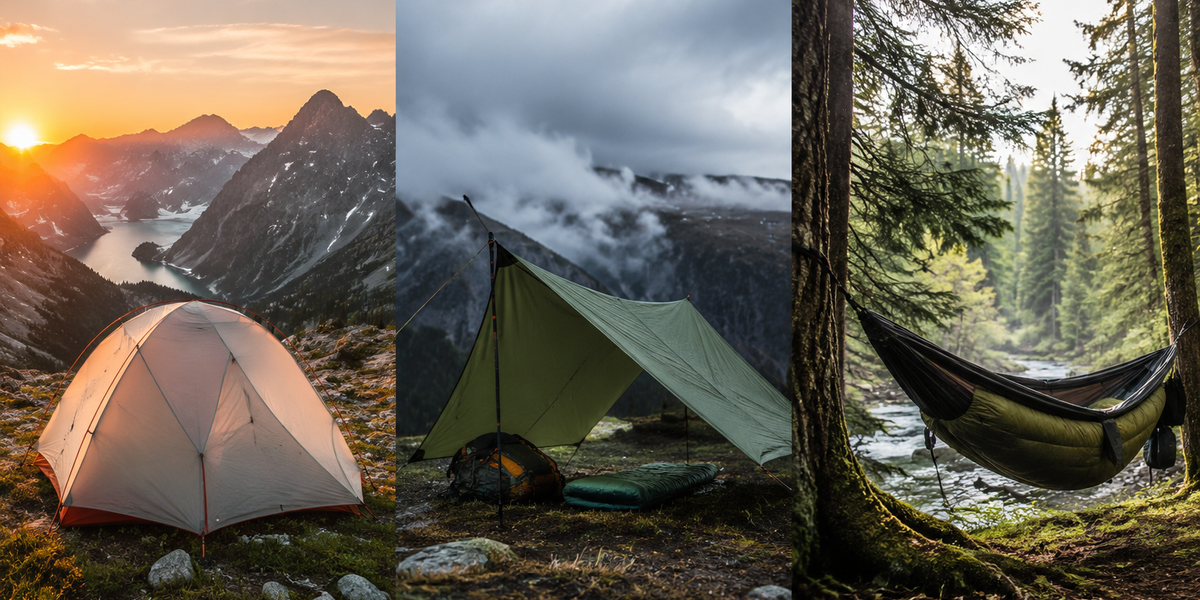
Every backpacking trip starts with the same question: what's going over your head tonight? Your shelter choice affects your pack weight, your sleep quality, your flexibility on terrain, and — when the weather turns ugly at 11,000 feet — your safety. Tent, tarp, or hammock each have passionate advocates, and honestly, each system deserves its reputation.
We've spent hundreds of nights testing all three across the Rockies, the Appalachians, and the Pacific Northwest. We've shivered under tarps in sideways rain, swung in hammocks through mugy Southern summers, and bailed on exposed ridgelines grateful for a bombereestanding tent. That experience is what drives this guide.
Below we'll walk you through every meaningful difference — weight, cost, setup complexity, weather protection, terrain requirements — so you can match a shelter system to the way you actually hike, not just the way you wish you did.
What to Look For
Before diving into the three systems, here are the criteria that matter most.
- Weight and pack volume: Ounces become pounds over long miles. A true ultralight shelter under 2 lbs can be transformative on a week-long trip, while a heavier budget tent is perfectly fine for weekend car-camping or short distances.
- Weather protection: A tarp offers minimal side protection in driving rain; a double-wall tent seals you off from the elements completely. Know your destination's weather window before you commit.
- Terrain and anchor options: Hammocks need trees12–18 feet apart and reasonably healthy. Tarps need a ridgeline plus good stake points. Tents — especially freestanding models — pitch almost anywhere, including granite slabs and desert hardpack.
- Setup speed and complexity: Caught in a squall at dusk, you want a shelter that goes up in minutes. Freestanding tents and structural ridgeline hammocks win here. Flat tarps reward practice.
- Versatility across seasons: Most shelters are rated3-season (spring through fall). True4-season tents handle winter loads; most tarps and hammocks require additional insulation systems to push into cold temperatures safely.
- Budget: The spread is enormous — from a $30 silnylon tarp to a $600 ultralight tent. We'll flag honest options at every price point.
Tent vs Tarp vs Hammock: Deep Dive
🏕️ Tents — The Reliable All-Rounder
Tents are the default shelter for good reason. They're self-contained, weather-proof, and work on virtually any surface. You're not dependent on trees, you're protected from bugs without a separate net, and a quality double-wall tent manages condensation in ways that tarps simply can't.
The trade-off is weight and cost at the premium end — though the gap has narrowed dramatically with modern materials like DCF (Dyneema Composite Fabric) and lightweight aluminum alloys.
Big Agnes Copper Spur HV UL2
| Criteria | Score |
|---|
| Weight & Packability | 10/10 |
| Weather Protection | 9/10 |
| Ease of Setup | 9/10 |
| Value for Weight | 8/10 |
\The Big Agnes Copper Spur HV UL2 sits at the top of the ultralight tent category and has for several years running. At 2.6 lbs for the full system, it's lighter than many single-wall shelters while delivering double-wall performance. The "High Volume" geometry means you actually have headroom to sit up and change layers — something flatter ultralight designs sacrifice. Two doors eliminate the tent-mate shuffle, and each door opens to its own vestibule for wet gear and mudy boots. In our testing, it handled sustained mountain thunderstorms without a drop of interior moisture.
✅ Pros:
- Ultralight 2.6 lbs — barely noticeable in your pack
- Two doors and vestibules eliminate the middle-of-the-night gymnastics problem
- Solo setup in under 5 minutes with color-coded clips and poles
❌ Cons:
- $549.95 is a serious investment — not a casual purchase
- Silnylon floor benefits from a footprint on sharp or rocky ground
---
MSR Hubba Hubba NX 2
| Criteria | Score |
|---|---|
| Weight & Packability | 8/10 |
| Weather Protection | 10/10 |
| Ease of Setup | 9/10 |
| Value for Weight | 9/10 |
If the Copper Spur is the athlete's choice, the MSR Hubba Hubba NX 2 is the workhorse. Its freestanding design means it pitches confidently on loose sand, snow, or slickrock where stakes fail. The Easton Syclone poles shed wind impressively, and MSR's Xtreme Shield coating keeps the fly performing trip after trip. Packing to just 20 oz for the trail weight, it punches well above its price in wet-weather performance.
✅ Pros:
- Freestanding — pitches on any terrain without good stake points
- Best-in-class rain and wind handling for a 3-season tent
- 20 oz trail weight is excellent for a two-person shelter
❌ Cons:
- Slightly heavier than the Copper Spur at a similar price point
- Mesh inner can feel cold on sub-freezing nights without a liner
---
TETON Sports Mountain Ultra Tent
| Criteria | Score |
|---|
| Weight & Packability | 6/10 |
| Weather Protection | 7/10 |
| Ease of Setup | 7/10 |
| Value for Weight | 10/10 |
Not everyone needs to spend $500on a tent, and the TETON Sports Mountain Ultra Tent makes that case convincingly at $89.99. Full fly coverage, a bathtub floor, and a reasonable interior footprint give beginers everything they need to get outside safely. It's heavier — around 5 lbs — so it's better suited to car camping or short-distance backpacking where weight isn't the primary concern.
💡 Pro Tip: If you're buying your first backpacking tent, start here. Learn what you like and don't like about shelter systems before investing $500+ in an ultralight option.
✅ Pros:
- Under $100 with full fly coverage — outstanding value
- Solid interior space for a budget tent
- Great learning platform for new backpackers
❌ Cons:
- ~5 lbs is heavy for multi-day backpacking
- Pole system has a steper learning curve than clip designs
---
🪢 Tarps — The Ultralight Minimalist Option
A silnylon or DCF tarp, a couple of trekking poles, and six stakes — that's it. Skilled tarp campers carry complete shelter systems under 12 oz. The sky-high ceiling of versatility is real: you can pitch a lean-to, an A-frame, a door configuration, or a flat fly depending on conditions. The flip side is exposure. Tarps leave your floor open to ground moisture, insects, and wind-driven rain unless you add a bivy or ground sheet, which erodes the weight advantage.
Tarps shine in arid climates, established ultralight thru-hiker communities (the PCT in summer is tarp country), and for experienced campers who read weather patterns well. They're a harder sell for humid or bugy environments.
💡 Pro Tip: If you're converting toarp camping, spend time in your backyard mastering the A-frame and lean-to configurations before you're doing it in the dark with a headlamp and incoming weather.
---
🌿 Hammocks — The Sleep-Quality Wild Card
Ask a dedicated hammock camper how they sleep on ground now and you'll get a pained expression. For back slepers and anyone who battles hip or shoulder pressure points on a sleeping pad, a hammock is genuinely transformative. The combination of a quality hammock, an underquilt for insulation below, and a top quilt creates a sleep system that many hikers consider the most comfortable in backpacking.
The restrictions are real though. You need two healthy trees,12–18 feet apart, at a usable diameter (roughly 6–18 inches). In alpine terrain above treline, canyon environments, or desert landscapes, you're carrying a useless system. Always carry a ground kit — tent or bivy — as backup if your trip includes uncertain tree coverage.
Weight-wise, a complete hammock system with bug net, underquilt, top quilt, and straps typically lands between 2–4 lbs, competitive with midrange tents but heavier than a minimalist tarp setup.
💡 Pro Tip: Hang your hammock with a30-degree sag angle — it looks too loose but creates the flat lay position that eliminates the dreaded "banana" that causes back pain.
---
Which System Is Right for You?
Choose a tent if:
- You camp in varied terrain including above treeline, desert, or exposed ridges
- You prioritize weather protection and don't want to think about it
- You camp with a partner who needs their own sleeping space
- You're a beginner building skills and want a forgiving system
Choose a tarp if:
- You're an experienced camper chasing the lightest possible kit
- You camp in climates with predictable, dry weather (Pacific Northwest summer, desert Southwest)
- You're comfortable with the setup and don't mind trading bug protection
Choose a hammock if:
- Your routes are consistently in forested terrain with available trees
- You struggle with sleep comfort on pads and mats
- You're willing to invest in a complete quilt system for cold-weather use
---
Frequently Asked Questions
Is a hammock warmer or colder than a tent?
Colder, unless you use an underquilt. Air circulates beneath you in a hammock, which pulls heat away rapidly — this is called "cold butt syndrome" and it's real. A quality underquilt rated to your expected low temperature solves the problem completely, but it adds cost and weight. In a tent with a good sleeping pad (R-value 4+), you're naturally insulated from below.
Can I use a tarp in rain without getting wet?
Yes, but it requires the right pitch and some experience. A tight A-frame with the ridgeline low and edges staked out to the ground performs well in driving rain. The vulnerability is wind-driven sideways rain and ground splash. Most experienced tarp users add a bivy sack or ground cloth to manage floor moisture.
What's the lightest shelter system for thru-hiking?
A DCF tarp plus a bivy sack can push under 10 oz total. For most thru-hikers who want weather protection without the worry, an ultralight single-wall tent or a quality shelter like the Big Agnes Copper Spur HV UL2 at 2.6 lbs hits the sweet spot of protection and weight.
Do I need a footprint with my tent?
For rocky or abrasive terrain, yes — a footprint protects your tent floor from puncture and significantly extends its life. For soft dirt or grass, it's optional. Many ultralight hikers skip it to save weight and carry a small patch kit instead.
What water filter should I carry regardless of shelter choice?
No matter which shelter you pick, clean water is non-negotiable. The Sawyer Squeeze Water Filter at 3 oz and $29.95 filters to 0.1 micron and is the one piece of gear we recommend to every hiker regardless of experience level. It pairs with any shelter system and never adds meaningful weight to your kit.
---
Final Thoughts
There's no universal best shelter — there's only the best shelter for your trip, your terrain, your sleep style, and your budget. Tents give you the most reliable all-conditions protection and are the right starting point for most hikers. Tarps reward experience with unbeatable lightness. Hammocks trade terrain flexibility for sleep comfort that dedicated fans swear by.
If we had to pick one system for the widest range of conditions and hikers, it's a quality3-season tent — and the Big Agnes Copper Spur HV UL2 is the one we'd spend our own money on without hesitation. But get outside, experiment, and let the terrain teach you what works for how you hike.
---
Editor's Choice
Big Agnes Copper Spur HV UL2 — the best all-around backpacking tent for hikers who want ultralight performance without sacrificing livability or weather protection.
MSR Hubba Hubba NX 2 — the freestanding workhorse that handles brutal weather on any terrain, ideal for hikers who camp in unpredictable conditions.
TETON Sports Mountain Ultra Tent — the smartest budget entry into backpacking shelter, giving beginers full fly protection and room to learn the craft without a painful upfront investment.