Disclosure: As an Amazon Associate, HikePod earns from qualifying purchases at no extra cost to you.
⭐ Our Top Pick
🏆 Best Overall: Big Agnes Copper Spur HV UL2 — at2.6 lbs with two doors, two vestibules, and a 5-minute solo setup, it's the gold standard for backpackers who refuse to compromise on weight or comfort.
>💰 Best Value: TETON Sports Mountain Ultra Tent — under $90 with full-fly rain coverage, it's the smartest way to get reliable3-season shelter without emptying your wallet.
Introduction
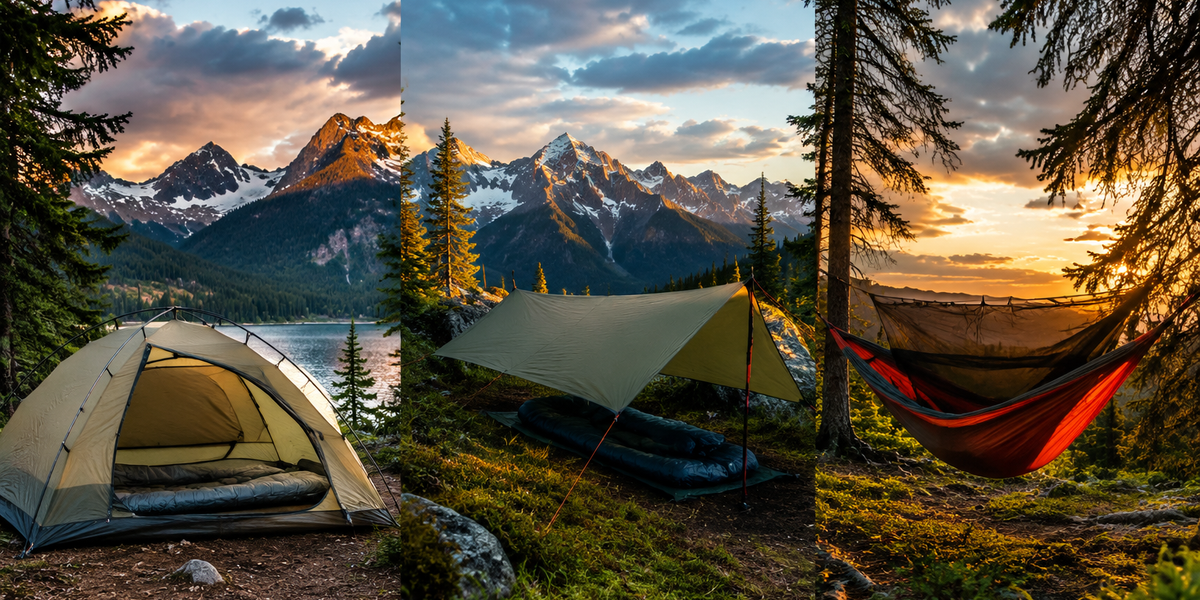
Stand in any gear shop in 2026 and you'll face the same three-way argument that's been splitting hiking groups for decades: tent, tarp, or hammock? Each has a tribe of devoted advocates, each tribe has a point, and the honest answer is that none of them is universally correct. The right shelter system depends on where you're going, how much weight you're willing to carry, how much weather you expect, and — let's be real — how much you enjoy fussing with guylines at 10PM in the dark.
We've spent years sleeping under all three systems across everything from the Appalachian Trail to the desert Southwest to the rainy Pacific Crest. We've woken up soaked in tarps that weren't pitched tight enough, tangled ourselves in hammock straps at 6,000 feet in the wind, and sweated through humid summer nights inside double-wall tents. That experience gives us a pretty clear picture of where each system excels and, more importantly, where it quietly fails you.
In this guide we'll walk you through the core trade-offs, score the top tent options on the market, and give you a direct decision framework so you can stopagonizing and start booking that permit. By the end, you'll know exactly which shelter system belongs in your pack.
💡 Pro Tip: Before you buy anything, identify your "home biome." A hammock camper thrives in the eastern forests of Appalachia but struggles on the treless ridges of the Rockies. Shelter choice is geography first, gear second.
What to Look For
Whether you're evaluating a tent, tarp, or hammock, these six criteria should drive your decision:
- Weight and Pack Size: Every ounce compounds over miles. For trips longer than two nights, aim for a shelter system under 2lbs for solo and under 3.5 lbs for two people — including stakes, guylines, and stuff sacks.
- Weather Protection: Consider your worst-case scenario, not your average night. A tarp that handles light drizzle is useless in a surprise thunderstorm. Check hydrostatic head ratings (1,500 mm minimum for3-season use; 3,000 mm+ for serious rain) and floor thickness for tents.
- Setup Speed and Complexity: Freestanding tents go up fast anywhere. Tarps and hammocks reward practice — give yourself at least three backyard runs before a real trip.
- Site Flexibility: Tents pitch on almost any flat(ish) ground. Hammocks need two healthy trees 10–15 feet apart. Tarps work on both but need anchor points or treking poles. Know what terrain you'll encounter.
- Ventilation and Condensation Management: Condensation is the silent enemy of a good night's sleep. Double-wall designs (a breathable inner + a waterproof fly with an air gap) dramatically outperform single-wall shelters in humid conditions.
- Price and Durability: Budget shelters save money upfront but often cost more in wet, miserable nights and early replacements. Spend as much as your budget allows on the one piece of gear you're inside every night.
Shelter System Deep-Dive
The Case for Tents
A tent is the most versatile, most forgiving, and — for most backpackers — the correct default. You can pitch one in the rain, sleep in it without worying about bugs or hypothermia, and not think about it again until morning. If you're new to backcountry camping, a tent is the right starting point, full stop.
Tents also cover the widest range of conditions. A well-designed 3-season tent handles everything from summer heat to shoulder-season snow, and true4-season mountaineering tents go further still. The trade-off is weight: quality ultralight tents cost serious money, and budget-friendly tents carry budget-friendly weight penalties.
---
Big Agnes Copper Spur HV UL2 Backpacking Tent
| Criteria | Score |
|---|
| Weight | 10/10 |
| Weather Protection | 9/10 |
| Interior Livability | 9/10 |
| Setup Speed | 9/10 |
| Value for Weight | 8/10 |
\The Big Agnes Copper Spur HV UL2 is the tent we recommend to every serious backpacker who asks us. At 2.6 lbs, it's lighter than some tarps with pole systems, and yet it pitches freestanding in under five minutes once you've done it once. The "HV" (High Volume) architecture gives you genuine sit-up headroom on both sides, and the two separate doors mean you and your partner stop crawling over each other in the middle of the night — a feature that sounds minor until the first time your tent partner needs a2 AM bathroom break. The silnylon fly sheds rain confidently, and both vestibules offer real storage for wet gear. At $549.95 it's an investment, but spread over five or ten years of trips, it's one of the cheapest nights of sleep you'll buy.
✅ Pros:
- Truly ultralight at 2.6 lbs — transforms long-haul days
- Two-door, two-vestibule design is a genuine quality-of-life upgrade for pairs
- Pitches freestanding on rocky, roty ground with no fuss
❌ Cons:
- $549.95 is a real barrier for casual or first-time backpackers
- Mesh inner works against you on cold nights without an extra layer or liner
---
MSR Hubba Hubba NX 2 Backpacking Tent
| Criteria | Score |
|---|
| Weather Protection | 10/10 |
| Weight | 8/10 |
| Interior Livability | 8/10 |
| Setup Speed | 9/10 |
| Value for Weight | 8/10 |
If you camp in genuinely wet conditions — Pacific Northwest, coastal trails, shoulder-season Sierra — the MSR Hubba NX 2 belongs on your shortlist. MSR's fully seam-taped fly and bathtub floor deliver some of the best rain performance in the freestanding tent category. We've had it pitched in multi-day Pacific Crest downpours and woken up completely dry. At a packed weight of 20 oz person for a two-person shelter, it punches well above its weight class. It's priced $50 less than the Copper Spur, making it a logical pick if weather performance matters more to you than squeezing out the last gram.
✅ Pros:
- Best-in-class rain performance for a sub-$500 two-person tent
- 20 oz packed weight is genuinely impressive
- Freestanding design works on hardpack, rock ledges, and sandy soil
❌ Cons:
- Slightly lower peak height than the Copper Spur limits comfort for taller campers
- Vestibule depth is modest — tight squeeze for two large packs
---
TETON Sports Mountain Ultra Tent
| Criteria | Score |
|---|---|
| Weather Protection | 7/10 |
| Weight | 6/10 |
| Interior Livability | 8/10 |
| Setup Speed | 7/10 |
| Value for Weight | 10/10 |
Not everyone needs to spend $500 on a tent, and the TETON Sports Mountain Ultra Tent is the best argument we know for that position. At $89.99 it offers a full-coverage fly, solid 3-season weather handling, and a roomy floor plan that gives new backpackers space to learn without feeling cramped. Yes, it's heavier than the premium options above — but if you're doing two or three overnight trips a year, that extra weight is not going to break you. Get this tent, learn what you love and hate about camping, and then invest in the ultralight stuff once you're hoked.
✅ Pros:
- Under $90 for genuine3-season protection is exceptional value
- Full-coverage fly controls condensation and rain effectively
- Roomy interior is forgiving for beginers learning to pack
❌ Cons:
- Heavier than ultralight alternatives — not suited for long-distance thru-hiking
- Pole system has a learning curve on the first few pitches
💡 Pro Tip: No matter which tent you choose, always seam-seal the floor before your first wet trip. Most manufacturers leave floor seams untaped to cut costs, and a $10 tube of seam sealer will save you from a sogy sleeping bag.
---
The Case for Tarps
Tarps are the shelter of choice for ultralight obsessives and experienced wilderness travelers who have developed a feel for weather and site selection. A silnylon or Dyneema tarp can weigh as little as 5 oz, leaves almost no footprint on the landscape, and — when pitched correctly — handles serious rain with nothing but physics and geometry.
The honest trade-off: tarps require skill and experience to use well. A poorly pitched tarp in sideways rain is a miserable experience. Bugs, condensation dripping off the edges, and cold drafts at ground level are all real issues you manage with technique rather than a zipper. For solo ultralight hikers on well-established routes with predictable weather, a tarp is a legitimate and excellent choice. For everyone else, it's an advanced option to work toward.
💡 Pro Tip: When using a tarp in bug season, pair it with a lightweight bivy sack or bug bivy insert. The combination weighs about the same as a budget tent but gives you the flexibility of a tarp with protection from insects.
---
The Case for Hammocks
Hammock camping has exploded in popularity over the past decade, and for good reason: sleeping suspended between trees, with zero ground contact, delivers some of the most comfortable nights in the backcountry. No roots poking your hip, no pudles under the floor, no searching for flat ground. For many campers in tree-dense environments, switching to a hammock is a revelation.
But hammocks have hard limits. They require two suitable trees within 10–15 feet of each other — no trees, no sleep. Above treline, in the desert, on beaches, or in heavily used campsites where vegetation is scarce, they simply don't work. Cold weather adds complexity too: without an underquilt insulating your back, you'll experience "cold butt syndrome" — the rapid heat loss through the compressed fabric beneath you. A full hammock system (hammock + rain tarp + underquilt + tree straps) often ends up weighing more than a lightweight tent and costing more too.
That said, if you hike primarily in the eastern U.S., the Southeast, the Appalachians, or any heavily forested region, a hammock system is worth serious consideration. The sleep quality alone converts most skeptics on the first night.
And wherever you pitch your shelter, make sure you've got clean water sorted. We always carry the Sawyer Squeeze Water Filter — at 3 oz and $29.95, it filters to 0.1 microns and fits any smart water bottle. Your shelter keeps you dry; the Sawyer keeps you healthy.
---
Tent vs Tarp vs Hammock: Quick Decision Framework
Still on the fence? Run through this quick checklist:
- Choose a tent if: you camp in varied terrain, you value weather protection and bug defense above all, you're a beginner, or you sometimes camp above treeline.
- Choose a tarp if: you're an experienced ultralight backpacker, you camp in mild and predictable weather, and you want the absolute minimum pack weight.
- Choose a hammock if: you camp almost exclusively in forested areas, you prioritize sleep comfort, and you're willing to carry and learn a slightly more complex system.
Frequently Asked Questions
Is a hammock warmer or colder than a tent?
Hammocks are significantly colder than tents unless you use an underquilt — an insulated pad or quilt that hangs beneath the hammock to stop heat loss through the compressed fabric under your body. With a proper underquilt, hammock camping can be as warm as tent camping. Without one, you'll lose heat rapidly even in mild temperatures. Budget for an underquilt before you budget for anything else in a hammock system.
Can you use a tarp in heavy rain?
Yes, but technique matters enormously. A flat tarp pitched with a low ridgeline and tight guylines will shed heavy rain effectively. Pitching too high, leaving gaps at ground level, or using a wrinkled tarp creates channels for water to run in. Practice your pitch in the backyard during a rain shower before trusting it on trail.
What's the lightest shelter system I can build?
A Dyneema composite tarp paired with a lightweight bivy sack and treking poles as ridgeline supports can come in under 12 oz total. That's the ultralight ceiling for most practical setups. Below 10 oz, you're deep into custom gear territory with significant cost and trade-offs in coverage.
Are hammocks Leave No Trace compliant?
Hammocks can be LNT compliant when used correctly. Always use wide tree straps (at least 1 inch wide, ideally 2 inches) to distribute pressure across the bark. Never hang from trees under 8 inches diameter or from visibly damaged trees. In heavily trafficked areas, move to a different tree pair each night if you're staying more than one night in a spot.
How do I choose between the Copper Spur and the Huba Hubba NX?
If you prioritize raw weight savings and interior space, go with the Copper Spur. If you hike in reliably wet conditions and want the most confidence in your rain protection, go with the Hubba NX. Both are excellent — you won't regret either. The $50 price difference is not meaningful at this level of quality.
Final Thoughts
There's no single best shelter system — there's only the right shelter for your terrain, your conditions, and your experience level. For most backpackers, most of the time, a quality lightweight tent is the safest, most versatile, and most forgiving choice. The Big Agnes Copper Spur HV UL2 represents the pinnacle of that category in2026. If budget is the constraint, the TETON Sports Mountain Ultra Tent will get you outside and sleeping comfortably for under $90.
Once you've got your shelter dialed in, add skills. Learn to pitch a tarp. Try a hammock weekend. The more systems you understand, the better backpacker you become — and the more you'll appreciate why experienced hikers debate this topic so passionately. Gear up, get out, and let the trail settle the argument for you.
Editor's Choice
Big Agnes Copper Spur HV UL2 — the best all-around tent for backpackers who want ultralight weight without sacrificing livability or weather protection.
MSR Hubba Hubba NX 2 — the go-to pick for wet-weather hikers who need maximum rain confidence in a freestanding, sub-500-dollar package.
TETON Sports Mountain Ultra Tent — the smartest beginner buy on this list, delivering real3-season shelter at a price point that removes every excuse not to start backpacking.