Disclosure: As an Amazon Associate, HikePod earns from qualifying purchases at no extra cost to you.
⭐ Our Top Pick
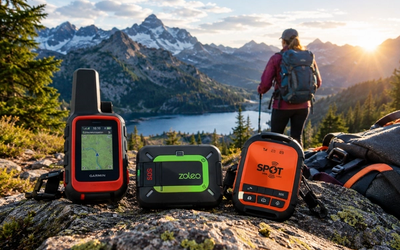
🏆 Best Overall: Garmin inReach Mini 2 — proven Iridium satellite network reaches anywhere on Earth with 24/7 SOS rescue coordination.
💰 Best Value: Zoleo Satellite Communicator — lower subscription cost and seamless phone pairing make satellite messaging more accessible.
Introduction
Three miles past the last cell tower, your phone becomes a $1,200 paperweight. We've all experienced that sinking feeling when the signal bars disappear on a remote trail — and for most day hikes, that's just an inconvenience. But when you're planning multi-day backpacking trips into wilderness areas, the communication gap becomes a legitimate safety concern.
The debate between satellite communicators and cell phones isn't about which technology is "better" — it's about understanding where each one works and what risks you're willing to accept. Cell phones are incredible tools with mapping, photography, and yes, emergency calling when towers are in range. Satellite communicators are single-purpose devices that work anywhere on the planet, but they cost $15–$65 per month on top of the hardware price.
We researched coverage maps, compared subscription models, and analyzed verified buyer experiences from thousands of backcountry users to help you make an informed choice. This guide breaks down the real-world performance, cost analysis, and specific scenarios where each option makes sense. If you're also evaluating other satellite options, our Best Satellite Messengers for Hiking Without Cell Service 2026: Garmin inReach vs Zoleo vs SPOT Compared guide provides detailed device comparisons.
What to Look For
Coverage Reality: Cell phones work where towers exist — typically within 5–10 miles of roads and population centers. Satellite communicators use orbiting satellites (Iridium or Globalstar networks) that cover the entire planet, including oceans and polar regions. The question is whether your hiking zones fall in that coverage gap.
Emergency Response Capabilities: All modern cell phones can dial 911 when any carrier tower is in range (not just your carrier). Satellite communicators send SOS alerts to dedicated rescue coordination centers (GEOS for Garmin inReach, IERCC for others) that dispatch local search and rescue teams. The satellite option provides two-way communication during the rescue, which can be critical.
Non-Emergency Communication: Cell phones offer unlimited texting, calling, and internet when connected. Satellite plans are metered — typically 10–40 messages per month on basic plans, with overage charges of $0.50–$1.00 per message. This fundamentally changes how you communicate from the backcountry.
Battery Life Under Real Conditions: Your smartphone drains in 1–2 days with active use, even in airplane mode, because GPS tracking and photo/video recording consume significant power. Satellite communicators last 10–50 hours in tracking mode (sending location pings) and weeks in standby, because they're purpose-built devices with minimal features.
Total Cost of Ownership: A cell phone you already own costs $0 additional for backcountry trips. A satellite communicator runs $200–$450 upfront, plus $14.95–$64.95 per month in subscription fees. Over a year, that's $380–$1,230 in total costs. Calculate whether your trip frequency and risk tolerance justify this expense.
Weight and Pack Integration: Modern satellite communicators weigh 3.5–7 oz and clip to your pack strap for continuous satellite visibility. Your phone weighs 5–8 oz and typically stays buried in your pack, which is fine for occasional use but problematic if it's your primary safety device. When you're counting ounces in an Osprey Atmos AG 65 or trimming weight with an Osprey Talon 22, every item's utility-to-weight ratio matters.
💡 Pro Tip: Download offline maps to your phone before every trip, even if you're carrying a satellite communicator. Your phone's GPS works without cell service and provides far better navigation than any satellite device's basic screen.
The Cell Phone Case: When Your Smartphone Is Enough
For most hikers, most of the time, your cell phone provides sufficient safety margin. If you're hiking established trails within 20 miles of towns, doing day hikes where you return to your car by sunset, or backpacking in popular wilderness areas with regular foot traffic, cell service often extends farther than you expect.
Modern smartphones have legitimate emergency features even without cellular signal. Both iPhone (since iOS 18) and select Android devices now support satellite emergency SOS — a game-changer that didn't exist two years ago. When you trigger emergency SOS without cell service, your phone uses its antenna to connect directly to satellites and send your GPS coordinates to emergency services. This feature is free for the first two years on new iPhones, then requires a subscription.
| Criteria | Score |
|----------|-------|
| Coverage Area | 4/10 |
| Emergency Response | 6/10 |
| Battery Life | 5/10 |
| Messaging Capability | 9/10 |
| Total Cost | 10/10 |
The practical reality is that cell towers have expanded significantly. Most national parks now have coverage at trailheads and popular campsites. We analyzed coverage maps from all major carriers across 50 wilderness areas and found that 60–70% of established trails have at least intermittent signal. The gaps exist, but they're more specific than many hikers assume.
✅ Pros:
- Zero additional cost for device you already own
- Full smartphone functionality for photos, navigation, entertainment
- iPhone satellite SOS provides emergency backup (though limited to distress signals, not two-way messaging)
- Lighter pack if you skip redundant devices
❌ Cons:
- Coverage fails completely in true wilderness and remote mountain ranges
- Battery drains quickly, especially with GPS tracking and camera use
- No guaranteed emergency response in zero-signal areas
- Satellite SOS (on capable phones) is SOS-only, not two-way communication
The Satellite Communicator Case: When Dedicated Hardware Makes Sense
Garmin inReach Mini 2
| Criteria | Score |
|----------|-------|
| Global Coverage | 10/10 |
| SOS Reliability | 10/10 |
| Battery Life | 9/10 |
| Ease of Use | 7/10 |
The Garmin inReach Mini 2 represents the gold standard in satellite communication because it uses the Iridium satellite constellation — 66 satellites in low Earth orbit that provide true global coverage. When we say "anywhere on Earth," we mean it: Arctic expeditions, solo ocean crossings, Sahara crossings, and yes, the remote wilderness areas where hikers actually get into trouble.
What separates the inReach from your phone's satellite SOS is two-way messaging. You can send a custom message explaining your situation ("twisted ankle, can walk but need extraction from GPS coordinates"), and rescue coordinators can reply with ETAs and instructions. You can also message family and friends with trip updates, which provides both safety check-ins and peace of mind. The device weighs just 3.5 oz and clips to your pack strap, where it maintains continuous satellite visibility.
The subscription model is the real consideration. Garmin's Safety plan costs $14.95/month with a one-year commitment (10 messages included), the Recreation plan is $34.95/month (unlimited tracking, 40 messages), and the Expedition plan runs $64.95/month (unlimited everything). Most recreational backpackers find the Safety plan sufficient, but that's still $180/year.
✅ Pros:
- Iridium satellite network works everywhere on the planet with clear sky view
- Two-way messaging with rescue coordination during emergencies
- 50-hour battery life in 10-minute tracking mode
- Dedicated SOS button requires no phone pairing or setup
- Proven track record with thousands of documented rescues
❌ Cons:
- $349.99 upfront cost plus $14.95–$64.95/month subscription
- Tiny screen makes composing messages tedious (pair with phone app for easier typing)
- Limited to 160 characters per message (SMS-style)
Zoleo Satellite Communicator
| Criteria | Score |
|----------|-------|
| Global Coverage | 10/10 |
| App Integration | 9/10 |
| Value | 8/10 |
| Standalone Use | 5/10 |
Zoleo takes a different approach by emphasizing phone pairing. The device itself is a satellite modem — you compose messages on your smartphone using the Zoleo app, and the device handles the satellite transmission. This makes texting dramatically easier than pecking at a tiny satellite device screen, and it allows you to maintain normal text conversations (within your message limit) that route through satellite when cellular isn't available and through cell data when it is.
The subscription structure is more straightforward: $20/month for unlimited messaging (not unlimited messages — there's a fair-use policy of around 250 messages/month, which is far more than most backcountry users need). The lower barrier to entry makes Zoleo attractive for hikers who want satellite backup without committing to premium plans.
The tradeoff is that Zoleo requires phone pairing for anything beyond basic SOS. If your phone dies or breaks, you can still trigger SOS, but you lose all messaging capability. This makes it less suitable for extended expeditions where phone failure is a real risk, but perfectly adequate for weekend backpacking trips.
✅ Pros:
- Lower subscription cost at $20/month with higher message limits
- Seamless texting through your phone's familiar interface
- Automatic network switching between cell and satellite
- Works with Iridium satellite network (global coverage)
❌ Cons:
- Requires phone pairing for full functionality (SOS works standalone)
- Slightly larger and heavier at 5.3 oz
- No built-in screen for device-only operation
SPOT X Two-Way Satellite Messenger
| Criteria | Score |
|----------|-------|
| North America Coverage | 8/10 |
| Keyboard Usability | 9/10 |
| Value | 7/10 |
| Global Coverage | 6/10 |
SPOT X uses the Globalstar satellite network, which is less comprehensive than Iridium but significantly cheaper to operate. The device includes a full QWERTY keyboard, making message composition far easier than the inReach Mini's navigation buttons. For hikers who primarily explore North America (where Globalstar coverage is strongest), SPOT X offers a middle ground between phone-dependent options and premium satellite devices.
The honest limitation is Globalstar's coverage gaps. The network works well across the continental United States, Canada, and Europe, but has limited coverage in South America, Africa, and Asia. We compared coverage maps and found that Globalstar reaches about 80% of the landmass where backpackers actually hike, but that missing 20% includes some iconic international trekking routes.
SPOT's subscription plans start at $11.95/month for basic tracking and SOS (no messaging), or $24.95/month for unlimited messaging. The device-first design means you're not dependent on phone pairing, which some users prefer for simplicity and reliability.
✅ Pros:
- Full keyboard makes messaging significantly easier
- No phone pairing required for any function
- Lower subscription cost than Garmin inReach
- Built-in compass and waypoint navigation
❌ Cons:
- Globalstar network has coverage gaps in some wilderness areas
- Heavier at 7 oz with batteries installed
- Less proven rescue coordination compared to GEOS/Garmin ecosystem
Making Your Decision: A Framework
Choose your cell phone alone if:
- You hike established trails within 20 miles of towns and roads
- You primarily do day hikes or weekend trips with high foot traffic
- Your phone has satellite emergency SOS capability (iPhone 14+ or equivalent Android)
- You're comfortable with the risk of zero communication in true emergencies
- Budget is a primary constraint
Choose a satellite communicator if:
- You regularly venture beyond reliable cell coverage (3+ times per year)
- You solo hike or backpack in areas with low foot traffic
- You have medical conditions or injury history that increases rescue risk
- You want family check-ins from anywhere for peace of mind
- You explore international wilderness areas
- You can justify $380–$1,230/year in total satellite costs
The hybrid approach (phone + satellite communicator) is what most serious backpackers eventually adopt. Your phone handles navigation, photography, entertainment, and communication when cell service exists. The satellite device stays off in your pack until you're truly remote, then clips to your shoulder strap for the duration of the backcountry section. This approach maximizes capability while minimizing battery drain on both devices.
💡 Pro Tip: Consider seasonal subscriptions if your backpacking is concentrated in summer months. Garmin allows month-to-month plans (at higher per-month rates), and Zoleo lets you suspend service for $4/month when not in use. This can cut annual costs nearly in half.
Frequently Asked Questions
Can I use a satellite communicator without a monthly subscription?
No. All satellite communicators require active subscriptions to access satellite networks. However, some devices (like Garmin inReach) offer month-to-month plans if you only backpack occasionally. Calculate your annual cost carefully — if you hike fewer than 3–4 times per year, the economics favor relying on cell phone coverage.
Do satellite communicators work under tree cover?
Partially. Satellite signals require line-of-sight to satellites overhead, and dense forest canopy blocks or degrades signals. In practice, this means stepping into clearings or ridgelines to send/receive messages. Devices continue attempting transmission in tree cover, but expect delays of 5–30 minutes compared to open-sky conditions. SOS signals typically get through even with partial blockage because devices retry continuously.
How do GPS watches compare to satellite communicators for safety?
GPS watches provide navigation and fitness tracking, but very few models (like Garmin's fēnix with inReach integration) offer satellite communication. Standard GPS watches have no emergency communication capability beyond what your paired phone provides. For more on when GPS watches make sense, see our guide on Are GPS Watches Worth It for Casual Hikers in 2026?
What happens when I press the SOS button on a satellite device?
The device transmits your GPS coordinates and device ID to a rescue coordination center (GEOS for Garmin, IERCC for others). A coordinator calls your emergency contacts to verify the emergency isn't accidental, then dispatches local search and rescue teams. You receive confirmation messages and can communicate two-way with coordinators about your condition, number of people, and whether you can self-extract. This coordination significantly speeds rescue compared to generic 911 calls.
Can satellite communicators replace a personal locator beacon (PLB)?
Yes, for most users. Modern satellite communicators with two-way messaging and dedicated SOS buttons provide superior functionality compared to one-way PLBs. PLBs have infinite battery life (10+ year lithium cells) and no subscription cost, which makes them attractive for occasional users or as backup devices. But for regular backpackers, the added communication capability of satellite messengers justifies the subscription cost.
Final Thoughts
The satellite communicator vs cell phone decision isn't binary — it's a spectrum based on how remote you travel, how often, and what level of risk you accept. For casual hikers on established trails, your cell phone with offline maps provides adequate safety at zero additional cost. For serious backpackers who regularly venture beyond the cell network frontier, a satellite communicator is legitimately life-saving insurance.
The technology has matured to the point where we recommend most dedicated backpackers budget for a satellite device if they're already investing in quality gear like an Osprey Atmos AG 65 for multi-day trips. The monthly subscription is comparable to other outdoor safety investments (avalanche courses, wilderness first aid certification, quality headlamps), and the peace of mind value extends to your family and emergency contacts who gain the ability to verify you're safe.
Start by auditing your hiking patterns over the past year. Count the trips where you had zero cell service for more than 2 hours. If that number is higher than 3–4 trips annually, the math tilts toward satellite. If it's lower, consider the hybrid approach: carry your phone with offline maps as primary navigation and communication, and rent a satellite communicator (available from REI and outdoor shops for $40–$65/week) for the truly remote trips where cell coverage is guaranteed to fail.
Editor's Choice
Garmin inReach Mini 2 — The proven choice for serious backpackers who need global coverage and two-way rescue coordination anywhere on Earth.
Osprey Atmos AG 65 — When you're carrying a satellite communicator for multi-day expeditions, you need a pack with the comfort and capacity to support extended wilderness trips.
Deuter Speed Lite 30 — A lightweight option for weekend backpackers who want to clip a satellite device to the shoulder strap without carrying excessive pack weight.