Disclosure: As an Amazon Associate, HikePod earns from qualifying purchases at no extra cost to you.
⭐ Our Top Pick
🏆 Best Overall: Black Diamond Spot 400-R Rechargeable Headlamp — IPX8 waterproofing, a red night-vision mode, and 400 lumens of hands-free light make this the one lamp we'd grab for any camping trip.
💰 Best Value: Petzl Actik Core Rechargeable Headlamp — hybrid USB-and-AAA power means you're never truly stranded without light, at a price most campers can justify without blinking.
Introduction
You're packing for a three-night trip and the gear list is almost done. Then someone in your hiking group asks the question that always sparks a debate: headlamp or flashlight? It sounds trivial until you're fumbling with a handheld torch at 2 a.m. trying to find the tent zipper, or squinting at your map while holding a light in your teeth.
We've spent years testing lighting gear on trail, at camp, and in conditions ranging from a dry Colorado summer to a soaked Pacific Northwest fall. The honest answer is that neither tool is universally better — but one is almost certainly better for you, depending on how you camp, how far you hike, and what you actually do after dark.
In this guide we cut through the marketing noise and give you a clear framework: what each light type does well, where it falls short, the key specs that actually matter in the field, and our top picks for 2026. By the end you'll know exactly what to add to cart.
What to Look For
Before we pit headlamp against flashlight, here are the criteria that separate a genuinely useful camping light from a drawer-filler:
- Lumens vs. beam pattern — Peak lumens grab headlines, but a well-designed flood beam at 150 lumens often outperforms a narrow 400-lumen spotlight for campsite use. Look for both a spot and a flood mode if you want versatility.
- Battery system — USB-rechargeable batteries are convenient at home but risky on a long trip far from power. The best lights either offer hybrid power (built-in battery plus standard AA/AAA fallback) or have exceptional battery life at mid-brightness settings.
- Water resistance rating — IPX4 handles splashes; IPX8 survives submersion up to 1 meter. For backpacking in variable weather, anything below IPX4 is a gamble.
- Weight and packability — Grams add up fast. A headlamp in the 2–3 oz range is barely noticeable; a heavy flashlight at 5+ oz competes with a meal's worth of food for space in an ultralight kit.
- Runtime at usable brightness — Manufacturers list max runtime at the lowest possible output. Find the runtime at a mid-range setting (150–250 lumens) — that's what you'll actually use around camp.
- Special modes — A red night-vision mode preserves your dark-adapted eyes and is essential if you share a tent. A strobe/SOS mode can be a genuine safety feature on remote trips.
Headlamp vs. Flashlight: The Core Trade-offs
Headlamps: Hands-Free Is a Game Changer
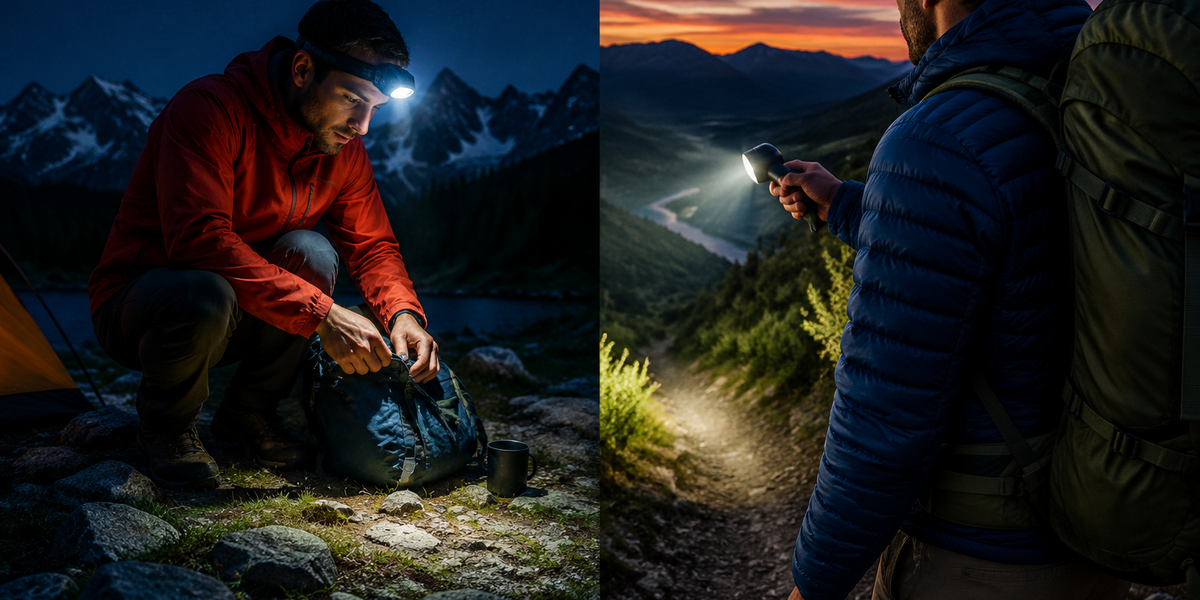
The single biggest advantage a headlamp has over any flashlight is that it points wherever you look and leaves both hands free. That matters more than most people realize until they try to cook a meal, set up a tent stake, or read a map in the dark with one hand occupied by a torch.
Modern headlamps have closed the brightness gap dramatically. The best models in 2026 push 500–1000 lumens — territory that was flashlight-only just five years ago. They're also lighter, more compact, and easier to stow in a hip-belt pocket.
The trade-off is comfort on long nights. A tight headband gets sweaty and can cause headaches on multi-hour use. And because the beam moves with your head, it can be harder to angle precisely for reading or close tasks where a tilting flashlight held at arm's length is more controllable.
💡 Pro Tip: If you wear glasses, look for a headlamp with a tilting head — you can angle the beam downward without tipping your whole head, which reduces glare off your lenses.
Flashlights: Raw Power With a Usability Cost
Flashlights still win on peak brightness and throw distance. A quality tactical flashlight can push 2000–3000 lumens down a focused beam, illuminating a trail or campsite perimeter far beyond what any headlamp can match. For car camping, overlanding, or any scenario where you need to light up a large area or signal across distance, a flashlight is hard to beat.
They're also more durable as a rule — thick aluminum bodies with proper heat sinking handle sustained high-output use better than the plastic shells on most headlamps. And they double as a self-defense tool in a way a headlamp simply doesn't.
The obvious downside is that one hand is always occupied. For backpacking — where every task from filtering water to hanging a bear bag requires two free hands — that's a real cost. Flashlights are also harder to keep in a pocket when not in use, and the awkward mouth-grip method for hands-free use is exactly as uncomfortable as it sounds.
💡 Pro Tip: Car campers and overland travelers often carry both — a headlamp for camp chores and a high-output flashlight for perimeter lighting and emergencies. The weight penalty is negligible when you're driving to the trailhead.
Product Reviews
Black Diamond Spot 400-R Rechargeable Headlamp
| Criteria | Score |
|---|---|
| Brightness & Beam Quality | 9/10 |
| Battery Life (mid-brightness) | 8/10 |
| Water Resistance | 10/10 |
| Weight & Comfort | 9/10 |
The Black Diamond Spot 400-R has been a trail-tested staple for years, and the 2026 version refines what was already a near-perfect backpacking headlamp. The 400-lumen max is more than enough for moving on trail at night, and the proximity mode automatically dims when it detects your hand close to the lens — a genuinely useful feature when reading in a tent. IPX8 waterproofing at this price point is rare and welcome; we've worn this lamp through driving Pacific Northwest rain with zero issues. The red night-vision mode is smooth and bright enough to navigate camp without killing your dark adaptation or waking a tentmate. USB-C recharging via a standard cable keeps the kit simple.
✅ Pros:
- 400 lumens with excellent flood coverage for campsite tasks
- IPX8 waterproofing — the best rating in its price class
- Red night-vision mode with a dedicated button for instant access
- USB-C rechargeable; no proprietary cables
❌ Cons:
- Lock mode button sequence takes a night or two to memorize
- No hybrid AAA fallback — a dead battery on a remote trip is a problem
---
Petzl Actik Core Rechargeable Headlamp
| Criteria | Score |
|---|---|
| Brightness & Beam Quality | 8/10 |
| Battery Life (mid-brightness) | 9/10 |
| Water Resistance | 7/10 |
| Weight & Comfort | 8/10 |
Petzl's Actik Core targets the backpacker who wants the convenience of USB recharging but isn't willing to gamble on it for a week in the backcountry. The hybrid system is its killer feature: run it on the integrated rechargeable battery at home and on a standard trip, but if that battery dies three days into a remote route, you can swap in three AAA batteries and keep going. The 450-lumen ceiling is slightly higher than the Black Diamond, and Petzl's smooth dimming delivers fine brightness control that rigid button steps can't match. Water resistance is solid at IPX4 but doesn't reach IPX8 — adequate for most conditions, but a step below the Spot in serious rain.
✅ Pros:
- Hybrid power: USB rechargeable battery + AAA fallback
- 450-lumen output with smooth dimming control
- Excellent runtime at mid-brightness (30+ hours at 100 lumens)
❌ Cons:
- IPX4 rating trails the Black Diamond Spot's IPX8 in wet conditions
- Headband can loosen during trail running or scrambling
---
Fenix PD36R Pro Tactical Flashlight
| Criteria | Score |
|---|---|
| Brightness & Throw Distance | 10/10 |
| Build Durability | 10/10 |
| Battery Life (high output) | 6/10 |
| Packability | 6/10 |
If you need to light up a campsite perimeter, signal across a valley, or simply want the most powerful portable light available, the Fenix PD36R Pro delivers. The 2800-lumen peak is legitimately impressive — it turns a dark forest clearing into something resembling dusk. Dual switches give instant access to turbo mode without cycling through lower outputs, and the aircraft-aluminum body feels like it could survive being driven over. The trade-offs are real: turbo mode burns through the 21700 battery in under two hours before thermal step-down kicks in, and at 3.7 oz it's a noticeable addition to a gram-counted pack. This is a car camper's, overlander's, or base-camp light — not a thru-hiker's tool.
✅ Pros:
- 2800-lumen ceiling with genuine long-throw beam distance
- Aircraft-grade aluminum body; built to survive hard use
- Dual-switch design for fast mode access
❌ Cons:
- Weight and size make it impractical for ultralight backpacking
- Turbo runtime is short; sustained high output triggers thermal limiting
Frequently Asked Questions
Is a headlamp or flashlight better for backpacking?
For backpacking, a headlamp wins almost every time. Hands-free operation is the defining factor when you need both hands for cooking, filtering water, setting up camp, or navigating technical terrain after dark. A quality headlamp like the Black Diamond Spot 400-R also weighs a fraction of a comparable flashlight.
What lumens do I need for camping?
For camp tasks — cooking, reading, navigating the tent — 150–250 lumens is genuinely sufficient. For moving on trail at night, 300–400 lumens gives you comfortable reaction distance. 500+ lumens is useful for technical terrain, emergencies, or when you want to light a large area. Don't chase peak lumens; chase runtime at mid-brightness.
Can I use a headlamp and a flashlight together?
Absolutely — and many experienced campers do. Car campers and overland travelers often keep a headlamp for hands-free tasks and a high-output flashlight for perimeter lighting or emergencies. The redundancy is also a safety net: if one fails, you still have light.
How do I preserve my night vision at camp?
Switch to red mode. Red light doesn't suppress the rod cells in your eyes the way white light does, so you can move around camp on red and still see reasonably well in the dark when you switch it off. The Black Diamond Spot 400-R has a dedicated red mode button — one press and you're there without cycling through other modes.
Are rechargeable headlamps reliable enough for multi-day trips?
Yes, with a caveat: know your battery life at the brightness you actually use. Most modern rechargeable headlamps will run 3–5 nights of camp use on a single charge at moderate brightness. For trips longer than a week, consider a hybrid model like the Petzl Actik Core that accepts standard batteries as a backup, or carry a small USB power bank.
Final Thoughts
The headlamp vs. flashlight debate has a clear winner for most campers: the headlamp. Hands-free operation, lower weight, and increasingly competitive brightness make it the smarter choice for backpacking, hiking, and general camp use. The flashlight earns its place in car camping kits, overlanding rigs, and emergency bags where raw output and rugged durability matter more than weight.
If you're buying one light for camping in 2026, make it a quality rechargeable headlamp — and the Black Diamond Spot 400-R is the one we'd put in your hands first. If you want backup power insurance for remote trips, pair it with the Petzl Actik Core's hybrid system. Either way, you'll be better equipped than 90% of people at the trailhead.
Editor's Choice
Black Diamond Spot 400-R Rechargeable Headlamp — our top pick for backpackers who want IPX8 waterproofing, a red night-vision mode, and USB-C convenience in one sub-$40 package.
Petzl Actik Core Rechargeable Headlamp — the smarter call for remote or multi-week trips where a dead battery isn't an option and hybrid AAA fallback power is worth the slight weight penalty.
Fenix PD36R Pro Tactical Flashlight — the right tool for car campers and overlanders who want serious throw distance and a virtually indestructible build that doubles as an emergency signaling device.