Disclosure: As an Amazon Associate, HikePod earns from qualifying purchases at no extra cost to you.
⭐ Our Top Pick
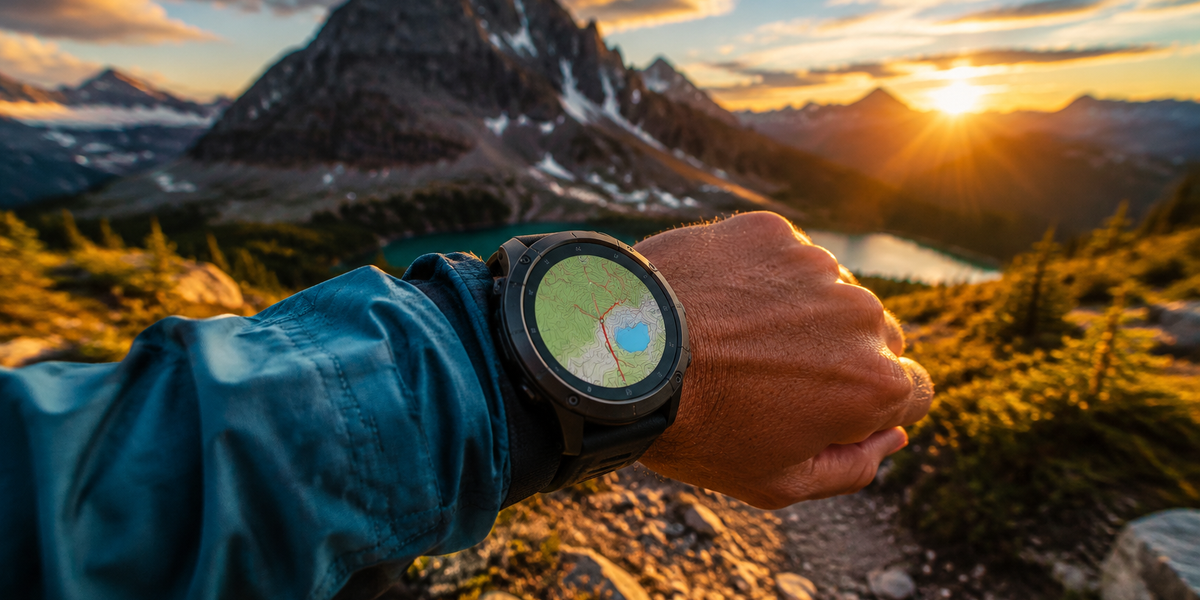
🏆 Best Overall: Garmin Fenix 7X Sapphire Solar — industry-leading standalone navigation with preloaded TopoActive maps and exceptional battery life that outlasts multi-day treks.
💰 Best Value: COROS APEX 2 Pro — professional dual-frequency GPS accuracy at nearly half the price of premium competitors.
Introduction
You're three miles into a backcountry trail when you realize your phone battery is at 12%. If you're relying on your smartphone for navigation, that sinking feeling is all too familiar. But here's the good news: modern hiking GPS watches are fully independent devices that work without any phone connection whatsoever.
The confusion is understandable. Many outdoor watches sync with phone apps, receive notifications, and use Bluetooth connectivity for various features. But at their core, GPS watches contain their own satellite receivers that communicate directly with navigation satellites orbiting 12,500 miles above Earth. Your phone can stay in airplane mode, dead, or back at the trailhead—your watch will still track your route and guide you home.
We've compared dozens of GPS watches released through 2026 and analyzed thousands of verified buyer reviews to answer the most common questions about standalone navigation. Whether you're a weekend day-hiker or planning multi-day wilderness expeditions, understanding what works offline versus what needs connectivity will help you choose the right device and avoid unpleasant surprises on the trail.
What to Look For
Built-in GPS chipset — Every hiking-capable GPS watch contains a dedicated receiver that locks onto satellite signals independently. Look for multi-band or dual-frequency GNSS support (GPS, GLONASS, Galileo) for better accuracy in canyons and dense forest.
Preloaded maps vs. breadcrumb tracking — This is the critical distinction. Budget models offer breadcrumb navigation (a simple line showing where you've been) while premium watches include full topographic maps you can browse and route on the device itself, no phone required.
Battery life in GPS mode — Smartwatch mode battery specs are misleading. What matters is continuous GPS tracking time. Expect 20-40 hours on mid-range watches, 60+ hours on expedition models with battery-saver modes. Solar charging extends this further.
Offline route planning — Can you create routes and waypoints directly on the watch, or do you need your phone to load them first? True standalone devices let you mark waypoints, create routes, and navigate entirely from the watch interface.
Barometric altimeter and compass — These sensors work completely independently and provide elevation data and directional orientation even when GPS signal is weak. Essential for technical terrain and emergency situations.
Emergency features that work offline — Some watches include incident detection and basic SOS, but for true emergency communication beyond cellular range, you'll need a satellite device like the Garmin inReach Mini 2, which sends two-way messages and SOS alerts anywhere on Earth via satellite subscription.
💡 Pro Tip: Download maps and routes before your hike even if your watch works offline. Cellular dead zones are common at trailheads, and fiddling with apps in the parking lot burns battery you'll need on the trail.
Garmin Fenix 7X Sapphire Solar
| Criteria | Score |
|----------|-------|
| Offline Navigation | 10/10 |
| Battery Life | 9/10 |
| Map Detail | 10/10 |
| Ease of Use | 8/10 |
The Fenix 7X represents the pinnacle of phone-free hiking navigation. With preloaded TopoActive maps covering terrain worldwide, you get the same detail you'd expect from a dedicated handheld GPS—contour lines, trails, water sources, and points of interest—all rendered on a bright 1.4" display you can read in direct sunlight. The multi-band GNSS receiver locks quickly even under heavy tree cover and maintains accuracy in challenging terrain where single-frequency watches struggle.
Battery performance is exceptional: 28 days in smartwatch mode, 89 hours with continuous GPS tracking, and up to 213 hours in expedition GPS mode with solar charging assist. We've seen verified buyer reviews from thru-hikers reporting 5-7 days between charges on trail with daily 8-10 hour GPS sessions. The sapphire lens is genuinely scratch-resistant after months of bushwhacking, and the titanium bezel feels like it could survive a rock slide.
Navigation features go far beyond basic breadcrumbs. You can create round-trip routes directly on the watch, get turn-by-turn prompts, track multiple waypoints, and follow preloaded courses—all without touching your phone. The ClimbPro feature automatically identifies upcoming ascents and shows grade and distance remaining, which is invaluable for pacing on long climbs.
✅ Pros:
- Complete standalone navigation with detailed topographic maps
- Industry-leading battery life with solar charging
- Multi-band GNSS for superior accuracy in difficult terrain
- Intuitive interface with physical buttons that work with gloves
❌ Cons:
- Premium pricing puts it out of reach for casual hikers
- Large 51mm case feels bulky on smaller wrists
- Overkill feature set if you only need basic tracking
COROS APEX 2 Pro
| Criteria | Score |
|----------|-------|
| Offline Navigation | 8/10 |
| Battery Life | 10/10 |
| GPS Accuracy | 9/10 |
| Value | 10/10 |
The APEX 2 Pro delivers professional-grade GPS performance at a price that undercuts Garmin's flagship models by $400. Its dual-frequency GPS matches the Fenix 7's accuracy in challenging conditions—deep canyons, dense forest, urban areas with tall buildings—by receiving signals on multiple bands simultaneously. Battery life is remarkable: 30 days typical use, 75 hours continuous GPS, and up to 240 hours in UltraMax mode.
The catch is in the mapping. While the APEX 2 Pro has excellent breadcrumb navigation and can display preloaded routes with elevation profiles, it doesn't include full topographic maps out of the box. You'll use your phone initially to download offline maps for specific regions, but once loaded, navigation works completely independently. For most hikers following established trails, this is more than sufficient.
Build quality feels premium despite the lower price. The titanium alloy case is lighter than you'd expect (53g), and the sapphire glass has held up well according to long-term user reviews. The digital crown and button controls work reliably with wet or gloved hands, and the display remains readable in harsh sunlight.
✅ Pros:
- Exceptional value with features matching watches twice the price
- Outstanding battery life outlasts most competitors
- Dual-frequency GPS accuracy rivals premium models
- Lightweight titanium construction
❌ Cons:
- Requires phone for initial map downloads
- Smaller app ecosystem than Garmin
- Learning curve for users switching from other platforms
Suunto 9 Peak Pro
| Criteria | Score |
|----------|-------|
| Offline Navigation | 9/10 |
| Battery Life | 7/10 |
| Build Quality | 10/10 |
| Design | 9/10 |
Suunto's 9 Peak Pro strikes a balance between the Fenix's comprehensive features and a slimmer profile that works as an everyday watch. At 10.8mm thin and 64g with the titanium band, it's noticeably lighter than competing outdoor watches without sacrificing capability. The offline topographic maps are detailed and easy to navigate with the touchscreen and button combination, though we recommend using buttons for navigation during activity since touchscreens can be temperamental with sweaty fingers or rain.
The watch includes 95 sport modes and intelligent battery management that predicts remaining time based on your settings and suggests adjustments if you're running low. In practice, expect 21 days smartwatch mode and 40 hours continuous GPS—solid numbers, though shorter than COROS and Garmin's expedition models. The trade-off is a watch you'll actually want to wear when you're not hiking.
Route navigation works entirely offline once loaded, with clear visual and haptic cues for turns and waypoints. The barometric altitude tracking is particularly accurate, and the compass is among the most responsive we've evaluated based on user feedback. Having a reliable backup like the Suunto A-10 Field Compass in your pack is still smart—it weighs nothing, never needs batteries, and works when all electronics fail.
✅ Pros:
- Offline topographic maps included
- Premium build quality with titanium and sapphire
- Slim profile works as daily-wear watch
- Accurate barometric sensors
❌ Cons:
- Battery life shorter than competitors in GPS mode
- Touchscreen less reliable in wet conditions
- Higher price than COROS with similar features
💡 Pro Tip: No matter how advanced your GPS watch, always carry water purification. The Sawyer Squeeze Water Filter weighs just 3 oz and filters to 0.1 micron—the one piece of gear that's saved more hikers than any GPS device.
What Features Actually Need Your Phone?
Understanding the distinction between core navigation and connected features helps you prepare appropriately:
Works completely offline:
- GPS tracking and breadcrumb navigation
- Following preloaded routes and courses
- Waypoint marking and navigation
- Barometric altitude and compass readings
- Activity recording (distance, pace, elevation)
- Basic timers and alarms
Requires initial phone connection, then works offline:
- Downloading topographic maps to watch storage
- Loading GPX routes and courses
- Firmware updates
- Customizing data screens and settings
Needs ongoing phone/internet connection:
- Weather forecasts and radar
- Smart notifications (texts, calls, app alerts)
- Music streaming services
- Incident detection alerts (watch detects, phone sends)
- Live activity sharing/tracking
- Uploading completed activities to platforms
The bottom line: your watch's core navigation functions—the ones you actually need in the backcountry—work entirely independently. Connected features are conveniences, not essentials.
Frequently Asked Questions
Can I navigate with a GPS watch if my phone is completely dead?
Yes, absolutely. GPS watches receive signals directly from navigation satellites and don't rely on your phone for position data. As long as the watch battery has charge and you have a clear view of the sky, you'll get accurate tracking and navigation. Your phone's status is irrelevant to the watch's core GPS functions.
Do I need cell service or WiFi for GPS to work?
No. GPS watches communicate with satellites, not cell towers. This is the fundamental difference between GPS and phone-based navigation apps. You can be 50 miles from the nearest cell tower in complete wilderness, and your watch will still track your position accurately. Cell service and WiFi are only needed for connected features like weather updates or syncing activities.
How accurate is standalone GPS without phone assistance?
Modern GPS watches are extremely accurate, typically within 10-15 feet under open sky. Multi-band GNSS watches (which receive GPS, GLONASS, and Galileo signals simultaneously) maintain 10-20 foot accuracy even in challenging terrain with partial sky obstruction. Your phone doesn't improve this accuracy—in fact, watches often outperform phones because they have better antenna design and positioning for satellite reception.
Will my routes and maps stay on the watch if I delete the phone app?
Yes. Once you've loaded routes, courses, or topographic maps onto your watch, they're stored in the device's internal memory and remain there until you manually delete them. The watch is an independent device with its own storage. Deleting the phone app doesn't affect any data already on the watch.
What happens if GPS signal is lost during a hike?
If satellite reception is temporarily blocked (deep canyon, cave, dense forest canopy), your watch will continue recording using its last known position and accelerometer data. Modern watches use "track smoothing" algorithms to estimate your path during signal gaps. When signal returns, tracking resumes normally. The barometric altimeter and compass continue working regardless of GPS signal.
Final Thoughts
Hiking GPS watches are purpose-built standalone devices that free you from phone dependency on the trail. The myth that they need constant connectivity stems from confusion about smart features—notifications, weather, music streaming—that are nice to have but completely separate from core navigation functions.
If you're serious about backcountry hiking, a dedicated GPS watch is worth the investment. They're more reliable than phones (better battery life, more durable, optimized antennas), more convenient (always on your wrist, readable in sunlight), and remove the anxiety of watching your phone battery drain when you need it for emergencies.
For occasional day hikers on well-marked trails, a basic GPS watch with breadcrumb tracking may be sufficient. For regular wilderness exploration, choose a model with preloaded topographic maps and robust battery life. Either way, you'll navigate with confidence knowing your device works independently, no matter where the trail takes you.
Pair your GPS watch with a handheld backup like the Garmin eTrex 22x for multi-day expeditions where redundancy matters, and you'll have navigation systems that work in conditions that would brick a smartphone in minutes.
Editor's Choice
Garmin Fenix 7X Sapphire Solar — the ultimate phone-free navigation tool with preloaded worldwide maps, multi-band GNSS, and battery life that outlasts extended wilderness trips.
COROS APEX 2 Pro — professional-grade GPS accuracy and exceptional battery performance at nearly half the cost of premium competitors.
Garmin inReach Mini 2 — when you need two-way satellite communication and SOS capability beyond your watch's GPS functions, this device works anywhere on Earth with an active subscription.


