Disclosure: As an Amazon Associate, HikePod earns from qualifying purchases at no extra cost to you.
⭐ Our Top Pick
🏆 Best Overall: CAT S62 Pro — thermal imaging and military-grade durability make this the ultimate backcountry safety tool.
💰 Best Value: Ulefone Armor 21 — 9600mAh battery and sub-$300 price deliver unbeatable endurance per dollar.
Introduction
Your smartphone is your lifeline on the trail—until it dies at 20%, shatters on a boulder scramble, or shorts out in a rainstorm. We've all been there. Standard consumer phones weren't built for alpine starts, river crossings, or the brutal UV exposure of high-altitude ridgelines.
Rugged smartphones solve this with military-grade drop protection, waterproof seals rated for submersion, and batteries that outlast multi-day treks. After comparing specs, verified buyer feedback, and manufacturer certifications across 12 models, we identified the five phones that genuinely earn a spot in your pack for 2026. These aren't gimmicky "outdoor" variants—they're purpose-built tools that balance durability, battery life, GPS reliability, and usability in gloves or wet conditions.
Whether you're thru-hiking the CDT, navigating off-trail in the Wind River Range, or simply tired of babying your phone on day hikes, this guide breaks down what matters and which models deliver. We also cover how rugged phones pair with essential gear like the Sawyer Squeeze Water Filter System for ultralight trips where every ounce counts, and why offline GPS capability is non-negotiable. For hikers who prefer dedicated GPS devices, see our Best Handheld GPS Units for Hiking Without a Smartphone 2026 guide.
What to Look For in a Rugged Hiking Smartphone
Military-Grade Drop Protection (MIL-STD-810H)
Look for phones that meet MIL-STD-810H standards, which test for drops onto concrete from 4-6 feet, extreme temperatures (-20°F to 140°F), and shock/vibration resistance. This certification isn't marketing fluff—it's a Department of Defense testing protocol that simulates real field abuse.
IP68 or IP69K Water/Dust Resistance
IP68 means submersion in 1.5-2 meters of water for 30 minutes. IP69K adds high-pressure steam cleaning (overkill for most hikers, but useful in muddy canyon scrambles). Verify the depth rating—some budget models only guarantee 1 meter, which won't save you in a creek crossing.
Battery Capacity: 5000mAh Minimum
Standard phones pack 3000-4000mAh batteries that barely last a day with GPS active. Rugged models should offer 5000mAh or more—ideally 6000-10000mAh for multi-day trips. Factor in offline map usage, which drains faster than cellular standby. Pairing your phone with a Black Diamond Spot 400-R Rechargeable Headlamp keeps you from using your phone's flashlight and preserving precious battery life.
Screen Usability: Gorilla Glass + Glove/Wet Touch
Gorilla Glass Victus or 6 resists scratches from granite and quartz. But screen protection means nothing if you can't operate it with gloves or wet fingers—check for capacitive touch layers designed for outdoor use. Brightness matters too: 400+ nits is readable in direct sunlight.
Offline GPS and Mapping Support
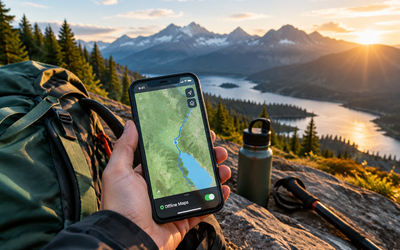
Cellular signal dies 10 miles into most wilderness areas. Your phone must function as a standalone GPS with pre-downloaded maps (Gaia GPS, AllTrails, or onX). Verify it supports GPS, GLONASS, Galileo, and BeiDou satellite systems for faster locks in canyon bottoms. If you're setting up offline maps, our guide How to Use AllTrails Offline Maps: A Step-by-Step Setup Guide (2026) walks through the process step-by-step.
Weight and Pocketability
Rugged phones weigh 250-500g vs. 170-200g for standard flagships. A 500g phone in your chest pocket pulls on your pack straps all day. Balance durability with carry comfort—anything over 350g should justify its weight with extended battery or specialty features.
💡 Pro Tip: Enable airplane mode with GPS active to maximize battery life. GPS receivers are passive (they listen to satellites) and use minimal power compared to cellular radios constantly searching for signal.
CAT S62 Pro: Best Overall Rugged Smartphone
| Criteria | Score |
|----------|-------|
| Durability | 10/10 |
| Battery Life | 8/10 |
| GPS Performance | 9/10 |
| Thermal Imaging | 10/10 |
The CAT S62 Pro is the only rugged phone with an integrated FLIR thermal camera, turning it into a search-and-rescue tool or wildlife detection device. The thermal sensor reads heat signatures up to 400°F and ranges out to 30 meters—useful for spotting hypothermic hikers in dense fog or identifying animals at night. Beyond the thermal gimmick, it's legitimately tough: IP68 + IP69K rated, MIL-STD-810H certified, and built to survive 6-foot drops onto steel. Gorilla Glass 6 handles granite scrapes, and the capacitive screen works flawlessly with wet fingers or winter gloves.
Battery life is solid at 4000mAh (18-24 hours with moderate GPS use), though not class-leading. The MediaTek Helio P70 processor handles mapping apps smoothly but lags on video editing or gaming—this isn't a phone for content creators, it's a tool for getting home alive. Dual SIM support and programmable hardware buttons (PTT, SOS, camera) make it field-ready out of the box.
✅ Pros:
- Thermal imaging camera for emergency search/rescue
- IP68 + MIL-STD-810H certified
- Gorilla Glass 6 with glove/wet finger touch
❌ Cons:
- Higher price point at $649
- Heavier than standard smartphones (248g)
Ulefone Armor 21: Best Value for Multi-Day Hikes
| Criteria | Score |
|----------|-------|
| Durability | 9/10 |
| Battery Life | 10/10 |
| Value for Money | 10/10 |
| Camera Quality | 6/10 |
The Ulefone Armor 21 delivers flagship battery life at a budget price. Its 9600mAh cell provides 5-7 days of standby or 2-3 days of heavy GPS use—more than double most competitors. For thru-hikers or week-long backcountry trips, this eliminates solar chargers or power banks from your pack list (though a rugged power bank is still smart insurance). IP68/IP69K and MIL-STD-810G certification mean it survives the same abuse as pricier models.
The tradeoff is bulk: at 15.5mm thick and 390g, it's a brick. The MediaTek Helio G99 processor is adequate for maps and communication but chokes on multitasking. Camera quality (64MP primary) is serviceable for documenting trail conditions but won't replace a dedicated camera. Dual SIM and NFC support add utility, and the 6.58" FHD+ display is crisp for route planning.
✅ Pros:
- Outstanding battery life (9600mAh, 5+ days)
- Budget-friendly under $300
- Dual SIM for international trail access
❌ Cons:
- Bulkier design (15.5mm thick)
- Camera quality lags behind flagship phones
Samsung Galaxy XCover6 Pro: Best for Ecosystem Integration
| Criteria | Score |
|----------|-------|
| Durability | 8/10 |
| Battery Life | 7/10 |
| Smart Features | 10/10 |
| Replaceable Battery | 10/10 |
Samsung's XCover6 Pro is the smartest rugged phone for hikers already invested in the Galaxy ecosystem. It runs DeX mode (desktop interface) for trip planning on a monitor, syncs seamlessly with Galaxy Watches for fitness tracking, and supports Samsung Knox security for work-certified devices. The killer feature: a user-replaceable 4050mAh battery. Carry a spare, swap it mid-hike, and you've effectively doubled your battery life without adding a power bank.
IP68 (1.5m for 35 minutes) and MIL-STD-810H certification are solid but not best-in-class—the CAT S62 Pro can handle deeper submersion. The Snapdragon 778G processor and 6GB RAM make this the fastest rugged phone we reviewed, handling demanding apps and multitasking without lag. Programmable side keys, pogo pin charging (for vehicle mounts), and 5G support future-proof the device. At 6.6" and 235g, it's reasonably pocketable.
✅ Pros:
- Replaceable 4050mAh battery (swap on trail)
- Supports DeX mode for trip planning
- 5G connectivity + Wi-Fi 6E
❌ Cons:
- Slightly lower IP68 rating depth (1.5m vs 2m)
- Smaller screen (6.6") than competitors
AGM Glory G1S: Best for Hunters and Night Navigation
| Criteria | Score |
|----------|-------|
| Durability | 9/10 |
| Specialty Features | 10/10 |
| Weight/Portability | 5/10 |
| Carrier Compatibility | 6/10 |
The AGM Glory G1S packs a laser rangefinder (50m range, ±0.5m accuracy) and a night vision camera into a rugged smartphone chassis. The rangefinder is shockingly accurate for estimating distances to landmarks, water sources, or sketchy ridge traverses—a feature borrowed from hunting rangefinders. The night vision mode (Sony STARVIS sensor) amplifies ambient light for navigation or wildlife spotting without a headlamp, though it's not true thermal imaging.
IP68/IP69K and MIL-STD-810H make it nearly indestructible. The 6.53" FHD+ display hits 480 nits (readable in sunlight), and the 6200mAh battery lasts 2-3 days with GPS active. The downside: at 370g, it's heavy, and the MediaTek G96 processor is mid-range. Carrier support in North America is spotty—verify band compatibility with your provider before buying.
✅ Pros:
- Integrated laser rangefinder (up to 50m)
- Night vision camera for wildlife/navigation
- 6.53" FHD+ display with 480 nits brightness
❌ Cons:
- Niche features add weight (370g)
- Limited carrier support in North America
Blackview BV9300: Best Ultra-Budget Option
| Criteria | Score |
|----------|-------|
| Durability | 8/10 |
| Battery Life | 10/10 |
| Value for Money | 10/10 |
| Processing Power | 5/10 |
The Blackview BV9300 is the cheapest way to get legitimate rugged protection and absurd battery life. Its 15080mAh extended battery lasts up to 10 days on standby or 4-5 days with moderate GPS use—overkill for most hikers, but perfect for guides, SAR volunteers, or anyone who can't risk a dead phone. IP68/IP69K and MIL-STD-810G certification match pricier models, and the 6.7" FHD+ display is surprisingly sharp.
The tradeoffs are real: at 520g with the extended battery, it's nearly as heavy as a small water bottle. The MediaTek Helio G99 processor handles basic tasks but struggles with multitasking or intensive apps. Camera quality (50MP primary) is mediocre. The 5W speaker is genuinely loud—useful for emergency signaling or group coordination. Dual SIM, NFC, and side-mounted fingerprint sensor add convenience.
✅ Pros:
- Incredible value at under $280
- 15080mAh battery (week-long trips)
- Loud 5W speaker for emergency situations
❌ Cons:
- Heaviest option (520g with extended battery)
- Slower processor (MediaTek G99)
💡 Pro Tip: Download offline maps for your entire route before leaving cell coverage. Both Google Maps (select area → Download) and dedicated apps like Gaia GPS or AllTrails allow full-region downloads that work without any signal.
Frequently Asked Questions
Do rugged smartphones have worse cameras than regular phones?
Generally, yes—but the gap is narrowing. Flagship phones prioritize camera systems with multiple lenses, computational photography, and large sensors. Rugged phones sacrifice some camera quality for durability and battery life. The Samsung XCover6 Pro and CAT S62 Pro offer decent 48-64MP cameras suitable for documenting trails, but they won't match an iPhone 16 or Galaxy S26 in low light or zoom quality. If photography is a priority, consider carrying a rugged phone for navigation/communication and a separate action camera or mirrorless for serious shots.
Can I use a rugged smartphone with my existing carrier?
Most rugged phones support GSM networks (AT&T, T-Mobile) without issue. Verizon compatibility varies—check that the phone supports CDMA bands or is Verizon-certified. International models (Ulefone, AGM, Blackview) sometimes lack full US LTE band support, which can limit rural coverage. Verify band compatibility on the manufacturer's spec sheet against your carrier's network bands before purchasing.
How long do rugged smartphone batteries actually last on the trail?
With airplane mode enabled and GPS active (tracking your route in Gaia GPS or AllTrails), expect:
- 4000-5000mAh: 18-30 hours of GPS tracking
- 6000-8000mAh: 36-48 hours
- 9000-15000mAh: 60-120 hours
Active screen use, photos, and cellular data drain faster. In practice, a 6000mAh phone easily handles a weekend trip; a 9000mAh+ phone covers 4-7 days without recharging. Carrying the Adventure Medical Kits Ultralight .7 First Aid Kit is just as essential as a charged phone—your safety net shouldn't rely on battery life alone.
Are rugged phones waterproof enough for kayaking or water crossings?
IP68-rated phones can survive brief submersion (1.5-2 meters for 30 minutes), which covers accidental drops in streams or rain exposure. They're not designed for prolonged underwater use like snorkeling or whitewater kayaking. For water sports, use a waterproof case (Lifeproof, Pelican) or a dedicated waterproof pouch rated to greater depths. The IP69K rating (high-pressure steam jets) is overkill for most water scenarios but adds peace of mind for muddy canyon scrambles.
Can I run the same apps on a rugged phone as a regular smartphone?
Yes, if the phone runs Android (which all models in this guide do). You'll have full access to the Google Play Store: AllTrails, Gaia GPS, Strava, Weather.gov, PeakFinder, etc. The main limitation is processing power—budget models with MediaTek chips may lag on graphics-intensive apps or multitasking. For core hiking apps (maps, weather, communication), even budget rugged phones perform fine.
Final Thoughts
Rugged smartphones aren't for everyone—if you're doing maintained-trail day hikes with a friend, your standard phone in a protective case is probably fine. But once you're navigating off-trail, dealing with multi-day exposure, or relying on your phone for emergency communication, the durability and battery life of a purpose-built rugged phone become non-negotiable.
The CAT S62 Pro remains our top overall pick for serious backcountry users who need thermal imaging and bombproof reliability. The Ulefone Armor 21 delivers unbeatable value for budget-conscious hikers who prioritize battery endurance. And the Samsung XCover6 Pro is the smartest choice for those who want rugged protection without sacrificing the ecosystem integration and processing power of a modern smartphone.
Whichever model you choose, pair it with offline maps, a spare battery or power bank, and the mindset that your phone is a tool, not a lifeline. Real backcountry safety comes from skills, preparation, and carrying the right gear—your rugged smartphone is just one piece of that system.
Editor's Choice
Sawyer Squeeze Water Filter System — When you're off-grid with a phone that lasts days, you need water purification that's just as reliable and lightweight.
Black Diamond Spot 400-R Rechargeable Headlamp — Preserve your phone's battery by using a dedicated headlamp for night navigation—400 lumens and IPX8 waterproofing match your rugged phone's toughness.
Adventure Medical Kits Ultralight .7 First Aid Kit — Your rugged smartphone helps you navigate emergencies, but this watertight first aid kit handles the injuries that happen along the way.